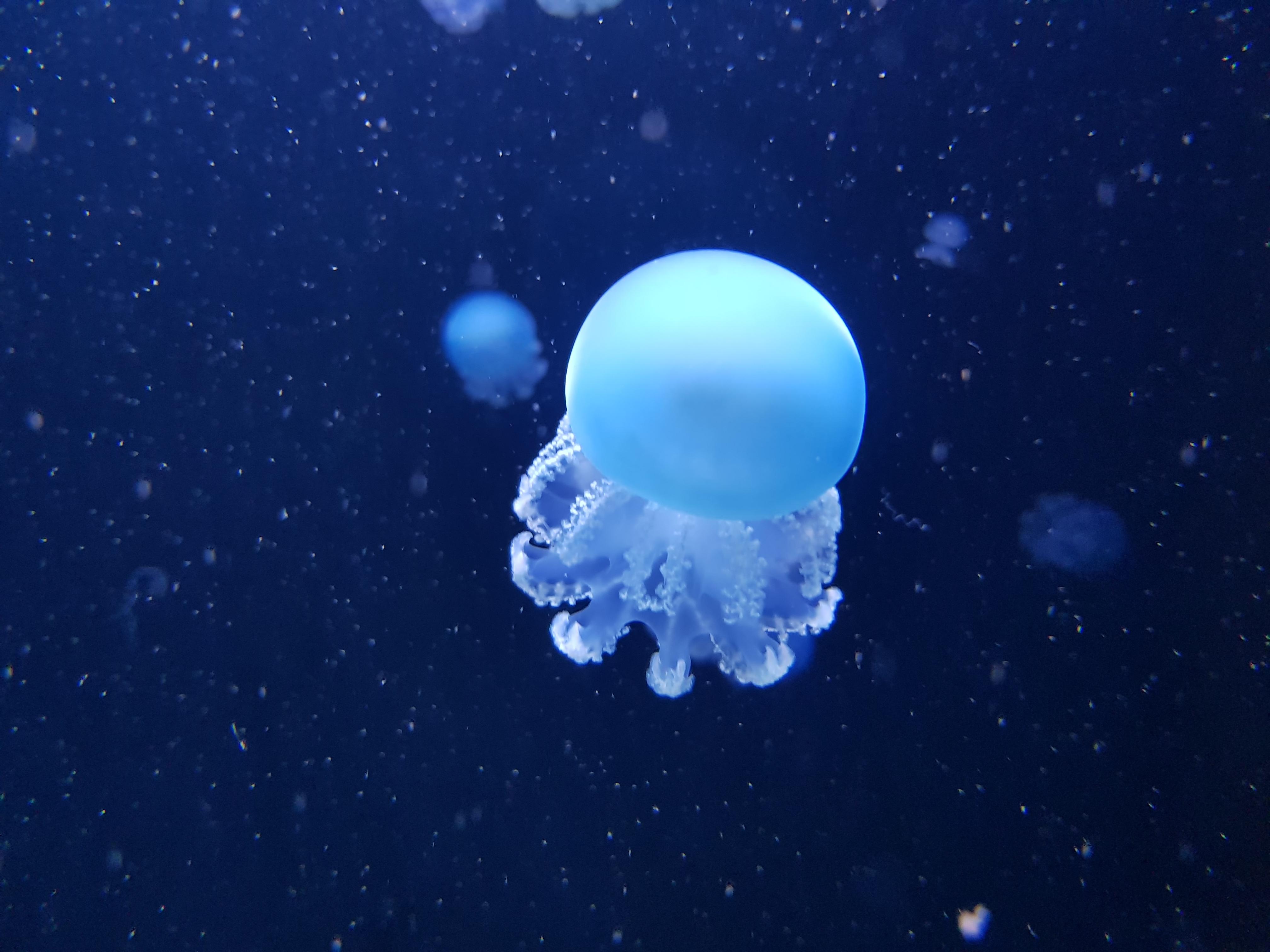
Most animals grow old and die. But one tiny creature cheats death. A jellyfish called Turritopsis dohrnii can turn back into a baby when it gets hurt or sick. This process is called transdifferentiation. It can happen over and over again. Scientists call it the "immortal jellyfish." It may be the only animal that can live forever under the right conditions.
📖 Level 1 - Beginner:
There is a very small jellyfish. It can live forever. Its name is the immortal jellyfish. When it gets old or hurt, it becomes a baby again. It starts its life over. This can happen many times. The jellyfish is smaller than a fingernail. It lives in warm oceans. Scientists study it closely. They hope to learn about human aging. This jellyfish is not truly magic. It can still die if eaten. But it never dies from old age. It is a very special animal.
📖 Level 2 – Intermediate:
Hidden in warm ocean waters around the world lives a creature that has amazed biologists: the immortal jellyfish, scientifically known as Turritopsis dohrnii. This tiny animal, no larger than a pinky fingernail, has the incredible ability to reverse its own aging process. When it becomes injured, stressed, or simply too old, it does not die. Instead, it transforms its cells back into a younger stage. Its body shrinks, reabsorbs its tentacles, and settles on the ocean floor as a polyp—the same form it had when it was first born. This process, called transdifferentiation, allows the jellyfish to start its life cycle all over again. In
theory, this can happen endlessly. That means the immortal jellyfish does not die from old age. However, it can still be eaten by predators or killed by disease. Scientists are studying this tiny creature to better understand cellular regeneration. They hope that one day, human medicine might use similar tricks to repair damaged organs or slow down aging.
📖 Level 3 – Advanced:
Among the myriad curiosities of marine biology, few are as
astonishing as Turritopsis dohrnii, a hydrozoan jellyfish commonly known as the immortal jellyfish. Measuring a mere 4.5 millimeters in diameter, this unassuming creature possesses a unique biological capability: ontogeny reversal. When faced with physical damage, starvation, or environmental stress, it bypasses conventional senescence by reverting to an earlier life stage. Specifically, the mature medusa transforms its cells through a process called transdifferentiation, whereby specialized cells (such as muscle or nerve cells) convert into different cell types. The jellyfish absorbs its tentacles, loses its bell shape, and settles onto a substrate as a polyp colony. From there, it can bud off new, genetically identical juvenile medusae, effectively resetting its biological clock. This cycle can theoretically repeat indefinitely, rendering Turritopsis dohrnii biologically immortal—it does not experience programmed death from aging. In practice, however, immortality is
rarely achieved, as predation and disease remain ever-present threats. Discovered in the late 1980s, the species has since spread to temperate and tropical oceans worldwide, likely via ballast water from ships. Researchers continue to study its cellular mechanisms in hopes of advancing regenerative medicine, wound healing, and age-related disease treatments. The immortal jellyfish may be tiny, but it holds profound secrets about the nature of life and death.

Comments (0)
Comments are published after admin approval.
No approved comments yet. Be the first to comment.