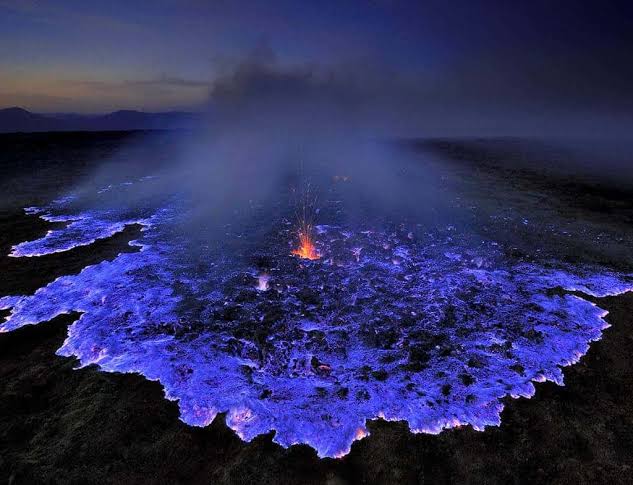
Most people think lava is always bright red or orange. But in Indonesia, a volcano called Kawah Ijen glows with electric-blue flames at night. This is not actually lava. It is burning sulfur gas. The blue fire looks like cold, flowing liquid. Scientists say this is one of the rarest natural phenomena on Earth.
📖 Level 1 - Beginner:
There is a volcano with blue fire. It is in Indonesia. The volcano is called Kawah Ijen. The blue flames come out at night. They look like glowing rivers. This is not real lava. It is burning sulfur. Sulfur is a yellow rock. When it burns, it turns blue. The fire is very hot. But it looks cold and blue. Many tourists visit to see it. Miners also work there. They collect solid sulfur. The place is dangerous but beautiful.
📖 Level 2 – Intermediate:
At Indonesia’s Kawah Ijen volcano, something strange happens after sunset. Bright blue flames pour down the rocky slopes like glowing rivers. Many people call this “blue lava.” However, it is not actually lava. Real lava is molten rock, which glows red or orange. The blue light comes from burning sulfur gas. The volcano releases hot sulfur gases through cracks. When these gases touch the air, they ignite and burn at temperatures over 600 degrees Celsius. The flames look electric blue. At night, the effect is magical. Inside the crater, there is also a large turquoise lake. It is highly acidic and dangerous. Local miners work there. They break off pieces of cooled yellow sulfur and carry heavy loads down the mountain. The blue flames are beautiful but toxic. Visitors must wear gas masks to breathe safely. This rare phenomenon happens in only a few places on Earth.
📖 Level 3 – Advanced:
Kawah Ijen, an active stratovolcano in East Java, Indonesia, exhibits one of the planet’s most extraordinary geological spectacles: electric-blue flames that appear to flow like liquid down its slopes. Although commonly dubbed “blue lava,” this phenomenon is not molten rock. True lava emits incandescent red-orange light due to thermal radiation. The blue glow at Kawah Ijen originates from the combustion of sulfur-rich gases. The volcano’s fumaroles release hydrogen sulfide and sulfur dioxide at high temperatures—often exceeding 600°C. As these gases escape through cracks and contact atmospheric oxygen, they ignite, producing characteristic blue flames that can reach up to five meters in height. At night, the flames reflect off the crater floor, creating the illusion of flowing blue rivers. Within the crater lies a large sulfurous lake with a pH near zero, making it one of the most acidic lakes on Earth. Despite the hazardous conditions—toxic gases, extreme acidity, and intense heat—local miners extract solidified sulfur deposits, hauling up to 90 kilograms per trip with minimal protective equipment. The blue fire phenomenon is not unique to Kawah Ijen, but few locations produce such continuous, visible displays. It serves as a dramatic reminder that Earth’s geothermal processes can be both breathtaking and deadly.
Newsletter
Get new articles by email
Level-appropriate English news when we publish. Free, no spam.
New stories
Free
Unsubscribe anytime
Comments (0)
Comments are published after admin approval.
No approved comments yet. Be the first to comment.

Comments (0)
Comments are published after admin approval.
No approved comments yet. Be the first to comment.