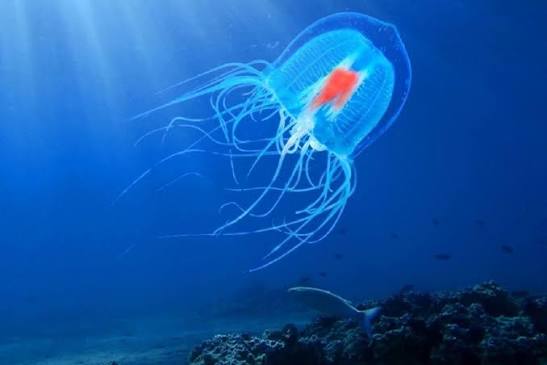
There is a tiny jellyfish in the ocean. It is called the immortal jellyfish. When it gets old or hurt, it does not die. It turns back into a baby. Then it grows up again. It can do this forever. It never dies of old age. Other animals eat it. But old age never kills it. Scientists want to learn its secret. They hope to help humans live longer.
📖 Level 2 – Intermediate:
In warm ocean waters lives a creature that has solved the problem of aging. Its name is Turritopsis dohrnii, better known as the immortal jellyfish. This tiny jellyfish, no bigger than a fingernail, has an extraordinary ability. When it becomes old, sick, or injured, it does not die. Instead, it transforms its cells back into a younger form. It turns into a polyp, which is the baby stage of a jellyfish. Then it grows into an adult again. This process is called transdifferentiation. It can repeat this cycle forever. In theory, this jellyfish never dies from old age. Only predators or disease can kill it. Scientists are studying the immortal jellyfish to understand aging better. If they can learn how its cells reverse time, they might help humans live longer, healthier lives. For now, the immortal jellyfish remains one of nature's strangest and most hopeful secrets.
📖 Level 3 – Advanced:
In the warm, temperate waters of the Mediterranean and the seas of Japan, a creature no larger than a human pinky nail has achieved what humanity has sought for millennia: biological immortality. Turritopsis dohrnii, commonly called the immortal jellyfish, possesses a unique life cycle that defies conventional aging. When most jellyfish reach old age or experience physical stress, they die. T. dohrnii, however, undergoes a process known as transdifferentiation. It reverts its existing cells — including muscle, nerve, and reproductive cells — back to their earliest form, becoming a polyp cyst. From there, it begins its life cycle anew, maturing once again into a free-swimming adult medusa. This cellular reset can be repeated indefinitely, making the jellyfish effectively immortal in the absence of predation or disease. The discovery, made by marine biologists in the 1990s, sent shockwaves through aging research. Scientists are now studying the jellyfish's genome to understand which genes control this remarkable ability. If the mechanism could be adapted for human medicine, it might lead to breakthroughs in tissue regeneration and age-related disease. For now, the immortal jellyfish remains a tiny, fragile, but infinitely hopeful miracle — a creature that simply refuses to die of old age, floating through the oceans like a living loophole in the laws of nature.
Newsletter
Get new articles by email
Level-appropriate English news when we publish. Free, no spam.
New stories
Free
Unsubscribe anytime
Comments (0)
Comments are published after admin approval.
No approved comments yet. Be the first to comment.

Comments (0)
Comments are published after admin approval.
No approved comments yet. Be the first to comment.