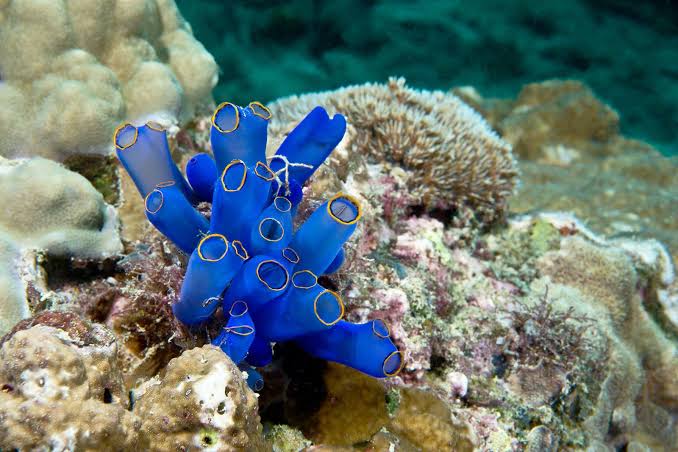
There is a sea creature called the sea squirt. It starts life with a brain. It swims in the ocean. Then it finds a rock. It attaches itself to the rock. It never moves again. It does not need its brain anymore. So it eats its own brain. The brain disappears. The creature lives without a brain. But if something hurts it, the brain can grow back. It can regrow its brain. This is one of nature's strangest tricks.
📖 Level 2 – Intermediate:
The sea squirt, also known as a tunicate, begins its life as a tiny swimming larva. At this stage, it has a simple brain and a nerve cord, much like a tadpole. The young sea squirt swims through the ocean until it finds a suitable rock or surface. Then it attaches itself headfirst and never moves again. Once attached, the sea squirt no longer needs to process complex information about its environment. So it does something astonishing: it digests its own brain. The brain is reabsorbed as nutrients for the rest of its body. The adult sea squirt becomes a filter-feeding bag of organs with no brain at all. However, recent scientific research has revealed an even more amazing ability. If the sea squirt is injured or its nervous system is damaged, it can regrow its brain and nerve cord. Scientists are studying this regeneration to understand how it might apply to human medicine. The sea squirt challenges our definition of intelligence and survival. It proves that sometimes, having a brain is only useful when you need to move.
📖 Level 3 – Advanced:
The tunicate, commonly known as the sea squirt, presents one of biology's most radical life-history strategies. A member of the phylum Chordata — the same phylum that includes humans — the sea squirt begins life as a free-swimming larva equipped with a notochord, a dorsal nerve cord, and a cerebral ganglion that functions as a primitive brain. This larval stage lasts only a few hours to days. During this window, the young sea squirt must locate a suitable substrate for permanent attachment. Once its head cements itself to a rock, the sea squirt undergoes a dramatic metamorphosis. It absorbs its own cerebral ganglion and most of its nervous system through programmed cell death (apoptosis) and autophagy. The resulting adult is essentially a sessile filter-feeder with no centralized brain — only a diffuse network of neurons in its siphons. For decades, scientists assumed this transformation was irreversible. However, groundbreaking research published in 2019 demonstrated that if the adult sea squirt's neural complex is damaged, it can regenerate a functional brain and nerve cord. This regeneration involves de-differentiation of cells and reactivation of developmental genes. The sea squirt thus challenges the conventional notion that brains, once lost, are lost forever. It offers a living model of extreme neuroplasticity and regenerative medicine. In the sea squirt, evolution has produced a creature that knows precisely when a brain is needed — and when it is not. And that, perhaps, is its own kind of intelligence.
Newsletter
Get new articles by email
Level-appropriate English news when we publish. Free, no spam.
New stories
Free
Unsubscribe anytime
Comments (0)
Comments are published after admin approval.
No approved comments yet. Be the first to comment.

Comments (0)
Comments are published after admin approval.
No approved comments yet. Be the first to comment.