
Why Sloths Are Nature's Couch Potatoes
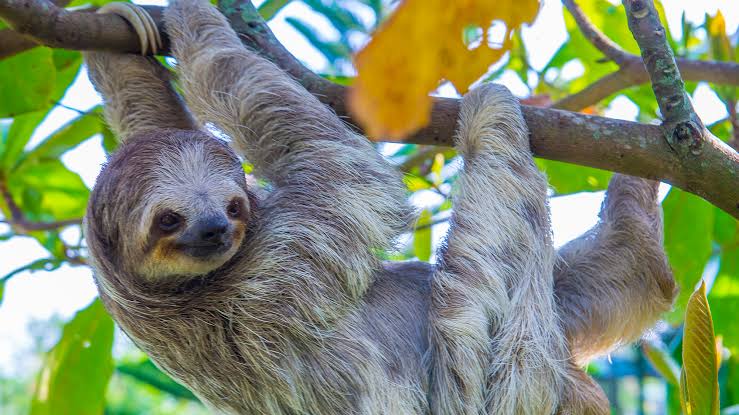
Sloths have a reputation for being incredibly slow. But did you know they are even lazier than you think? These tree-dwelling mammals move so little that algae grow on their fur. They can hold their breath longer than dolphins. And they sometimes grab their own arms by mistake and fall out of trees. Sloths are the true champions of doing nothing.
📚 Vocabulary
Words from this article that appear in our vocabulary books.
| Word | Definition |
|---|---|
| Actually | 1) in fact used to emphasize the real or exact truth of a situation 2) (spoken) used to add new information to what you have just said, to give your opinion, or to start a new conversation |
| Albeit | even though: although |
| Amusement | something that holds interest and is enjoyable # diversion |
| Arms | FML weapons, especially those used by the armed forces |
| Average | normal or typical |
| Barely | just, scarcely, hardly, narrowly, only with great difficulty or effort |
| Being | creature, existence |
| Branch | division |
| Breath | the air that goes into and out of your lungs |
| Camouflage | hide: blend with circumstances: decorate: disguise |
| Can | used with see, smell or taste in the continuous tense |
| Coarse | not fine or smooth; not delicate # rough |
| Consequently | therefore: thus: as a result |
| Daily | something issued every day |
| Diet | the food person eats |
| Due | expected to arrive or happen |
| Dwelling | where people live # house |
| Energy | the ability to be very active without getting tired |
| Even | at the same level |
| Excellent | be very good at, excel at/in sth |
| Exclusively | only: solely |
| Exhibit | display; show |
| Extreme | much hotter, colder, or more violent than usual |
| Eyesight | the ability to see, sight. good/poor eyesight |
| Fall | decrease; go lower (SYN drop) |
| Fascinating | extremely attractive |
| Fine | a sum of money you have to pay if you break a law |
| Fur | the thick hair that covers the bodies of some animals |
| Grasp | understan |
| Grow | increase SYN go up, rise |
| Heart | an organ which moves blood in the body |
| Hide | conceal |
| Hold | support-keep up |
| However | yet, but |
| Human | connected with people |
| Intermediate | in-between |
| Lazy | not able to work with effort and for a long time |
| Leaves | PLURAL of leaf |
| Leisure | free time |
| Let | allow to do sth |
| Like | used to introduce an example (SYN such as) |
| May | used to express possibility |
| Might | used to express the possibility that something will happen or be done, or that something is true although not very likely |
| Motion | the state of changing one's position; to direct by moving # movement |
| One | 1 |
| Per | for each |
| Rainforest | a forest in a tropical area that receives a lot of rain |
| Rare | scarce: unusual, infrequent |
| Rate | classify, consider to be of a certain quality, standard, or rank. |
| Remains | parts of objects and buildings that have been discovered recently |
| Reputation | fame |
| Several | more than two, but not many |
| Sleep | the resting state in which the body is not active and the mind is unconscious |
| Sluggish | slow-moving or inactive. yawny |
| Specifically | specially |
| Speed | increase the rate of v. |
| Take | require |
| Tough | difficult, strict, able to deal with difficulties |
| Underwater | under the surface of the water |
| Unlikely | not probable # doubtful |
| Win | do the best in a competition |
Comments (0)
Comments are published after admin approval.
No approved comments yet. Be the first to comment.