A long time ago in Iran, there was a smart man. His name was Al-Khwarizmi. He loved numbers. He wrote a famous book about solving math problems. His book was called "Al-Jabr." That word became "Algebra." He also taught people about the number zero. Without him, computers would not work. His ideas changed the whole world. Today, students everywhere learn his math. Most do not know his name.
📖 Level 2 – Intermediate:**
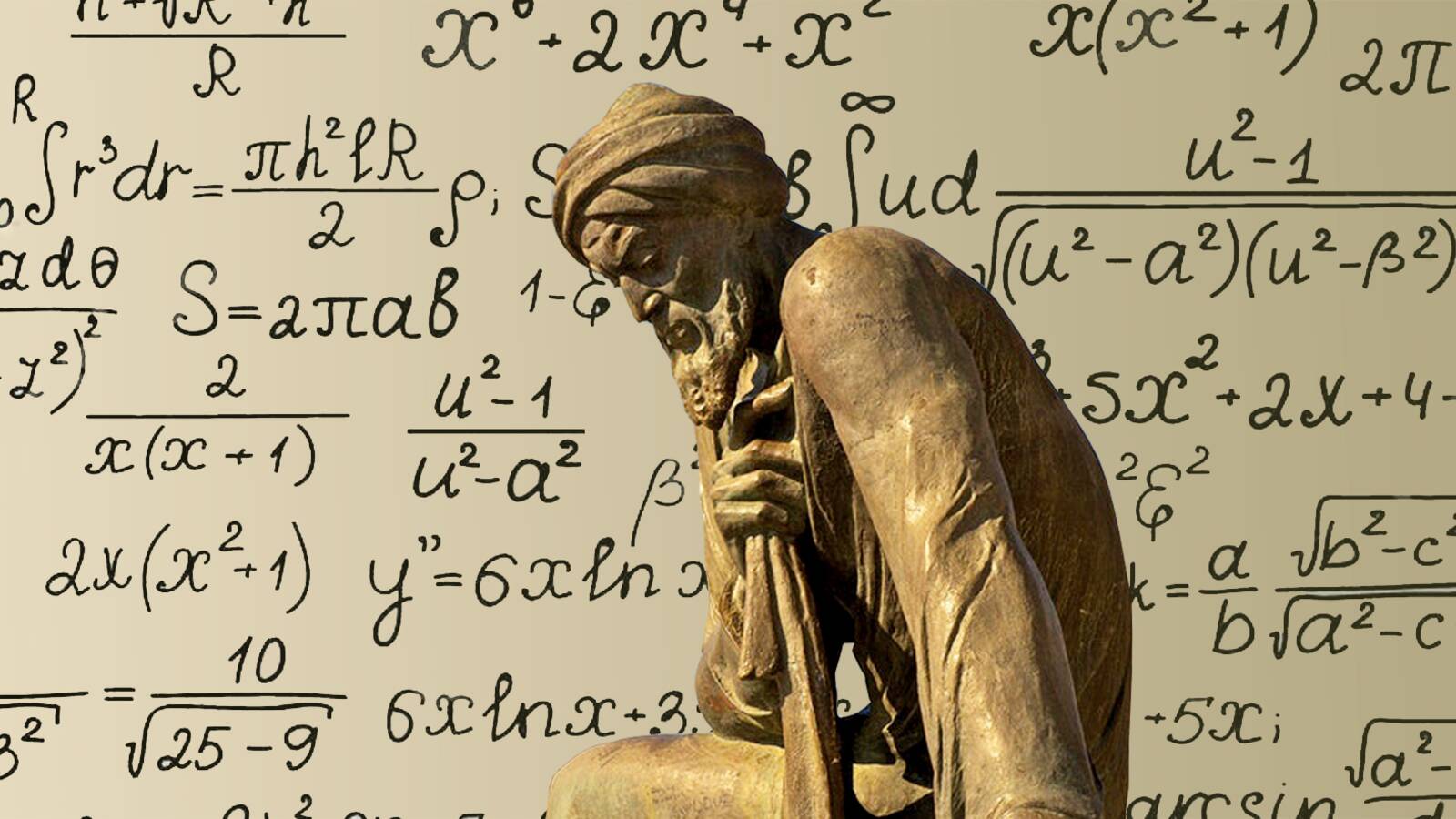
In the 9th century, during the Islamic Golden Age, a Persian scholar named Muhammad ibn Musa al-Khwarizmi changed mathematics forever. He was born around 780 CE in Khwarazm, which is in modern-day Uzbekistan and Turkmenistan. But he did most of his important work in Baghdad, at the House of Wisdom—a famous library and research center. Al-Khwarizmi wrote a book titled "Al-Kitab al-Mukhtasar fi Hisab al-Jabr wal-Muqabala." The title means "The Compendious Book on Calculation by Completion and Balancing." That long Arabic word "al-jabr" became the English word "algebra."
But algebra was not his only gift to the world. Al-Khwarizmi also wrote a book about Indian numbers. In that book, he explained how to use the number zero and the decimal system. When his book was translated into Latin centuries later, European mathematicians learned these ideas. The word "algorithm" comes from his Latinized name: "Algoritmi." So every time you use a computer or solve for x in math class, you are using the work of one Persian mathematician from over 1,200 years ago. He did not just invent algebra. He invented the way we think about numbers.
📖 Level 3 – Advanced:
If you have ever solved for x, used a computer, or followed a recipe, you have benefited from the work of Muhammad ibn Musa al-Khwarizmi. Born around 780 CE in the region of Khwarazm (in what is now Uzbekistan), al-Khwarizmi was a scholar at the Abbasid Caliphate's legendary House of Wisdom in Baghdad. His intellectual environment was extraordinary: he had access to Greek, Indian, and Persian texts, which he synthesized into something entirely new. In 820 CE, he completed his most famous work, "Al-Kitab al-Mukhtasar fi Hisab al-Jabr wal-Muqabala" ("The Compendious Book on Calculation by Completion and Balancing"). The word "al-jabr" (meaning "reunion" or "completion") referred to the method of moving negative terms from one side of an equation to the other. When this book was translated into Latin in the 12th century by Robert of Chester, "al-jabr" became "algebra."
But al-Khwarizmi's influence extends far beyond that single word. His second major work, "On the Calculation with Hindu Numerals," introduced the Indian decimal system—including the revolutionary concept of zero—to the Islamic world and, later, to Europe. The Latin translation of this book begins with the phrase "Dixit Algoritmi" ("Thus said Al-Khwarizmi"). From that phrase, we get the modern word "algorithm." Every search engine, every navigation app, and every piece of software ever written relies on algorithms. Without al-Khwarizmi, there would be no computer science as we know it.
Al-Khwarizmi died around 850 CE, but his intellectual legacy is immeasurable. The term "algebra" is now universal. The decimal system he championed is how the entire world counts. And the concept of an algorithm—a step-by-step procedure for solving a problem—is the foundation of the digital age. In a very real sense, every time you type a search into Google or solve a quadratic equation, you are whispering the name of a Persian mathematician from 1,200 years ago. You just did not know it until now.
Newsletter
Get new articles by email
Level-appropriate English news when we publish. Free, no spam.
New stories
Free
Unsubscribe anytime
Comments (0)
Comments are published after admin approval.
No approved comments yet. Be the first to comment.

Comments (0)
Comments are published after admin approval.
No approved comments yet. Be the first to comment.