
The Bronze Device That Detected Earthquakes in 132 AD

The Bronze Device That Detected Earthquakes in 132 AD banner
📖 Level 1 - Beginner:

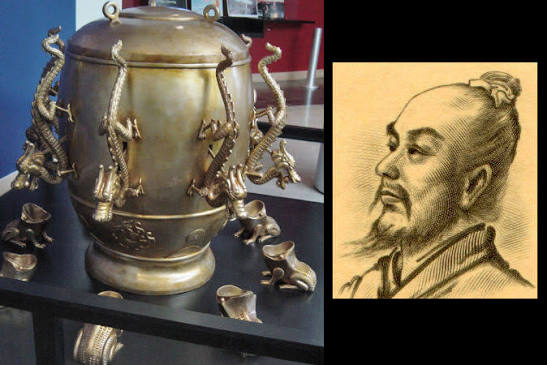
In 132 AD, a Chinese man named Zhang Heng invented a strange machine. It was made of bronze. It looked like a large jar or vase. Around the jar were eight dragons. Each dragon held a bronze ball in its mouth. Below each dragon sat a metal frog. When an earthquake happened far away, the machine dropped a ball. The ball fell into the frog's mouth. People knew an earthquake had occurred. They could tell which direction it came from. This was the world's first earthquake detector.

📖 Level 2 – Intermediate:

Nearly 1,900 years ago, during China's Han Dynasty, an inventor named Zhang Heng created the world's first seismoscope — a device that could detect earthquakes from hundreds of kilometers away. The instrument was called "Houfeng Didong Yi," which means "instrument for measuring seasonal winds and earth movements." It was made of fine bronze and shaped like a large wine jar. Around the outside of the jar were eight dragon heads, each facing a different direction: east, south, west, north, and the four diagonal directions. Inside each dragon's mouth was a small bronze ball. Directly below each dragon sat a bronze frog with its mouth open. When an earthquake occurred, a pendulum inside the jar would swing and trigger a mechanism. The dragon facing the direction of the earthquake would release its ball. The ball would fall with a loud clink into the frog's mouth below. Court officials could then know both that an earthquake had happened and which direction it came from. The device worked even for earthquakes that people could not feel. Zhang Heng's invention was 1,600 years ahead of the first modern seismograph developed in Europe.

📖 Level 3 – Advanced:

Long before the invention of modern seismographs, ancient China produced one of history's most remarkable scientific instruments. In 132 CE, during the Eastern Han Dynasty, the astronomer, mathematician, and engineer Zhang Heng unveiled a device he called the "Houfeng Didong Yi" — "instrument for measuring the seasonal winds and the movements of the Earth." Constructed from fine bronze, the seismoscope stood approximately 1.8 meters tall and resembled a large ceremonial wine jar or a barrel. Its exterior featured eight ornate dragon heads, positioned at the eight cardinal and intercardinal compass points (north, south, east, west, northeast, northwest, southeast, and southwest). Each dragon held a polished bronze ball in its jaws. Directly beneath each dragon, a bronze frog sat with its mouth gaping upward. Inside the device, Zhang Heng ingeniously placed a central pendulum linked to a system of levers and cranks. When seismic waves — even those imperceptible to humans — caused the ground to vibrate, the pendulum would swing in the direction of the disturbance. This motion triggered a specific arm that pushed open the jaw of the corresponding dragon, releasing its ball. The bronze sphere would fall with an audible clink into the frog's mouth below. Court officials, upon hearing the sound, would know immediately that an earthquake had occurred and which direction the epicenter lay. Remarkably, historical records document that on one occasion, the device dropped a ball indicating a quake to the west. Days later, a messenger arrived confirming that an earthquake had struck the Longxi region (modern-day Gansu Province), hundreds of kilometers away. Zhang Heng's seismoscope was the first known device in human history capable of detecting remote earthquakes. Comparable technology would not appear in Europe until the 19th century — nearly 1,700 years later. Today, replicas of Zhang Heng's bronze dragon jar are displayed in science museums around the world, a testament to ancient Chinese ingenuity and the timeless human desire to understand the restless earth beneath our feet.

📚 Vocabulary

Words from this article that appear in our vocabulary books.

Word Definition
Ancient antique: old- belonging to a long time in old history
Appear seem; arise; opposite of vanish -come into sight; become visible or noticeable, typically without visible agent or apparent cause
Approximately roughly-more or less than a number or amount
Audible able to be heard
Cardinal fundamental, basic, essential, vital, main, prime/~ importance/rule/principle/number
Central essential, more important and having more influence than anything else
Century 100 years
Comparable equivalent, similar to something so that we can make a comparison
Court a ​place where ​trials and other ​legal ​cases ​happen
Desire a strong wish (have no desire to do sth)
Detect find out; discover
Detected identified, specified
Device an object or piece of equipment designed to do a particular job
Diagonal A line which is ​straight and ​sloping, not ​horizontal or ​vertical
Document something handwritten or printed that gives information of proof of some fact
During at a point of within a period of time
Earth our planet
Earthquake sudden violent movement of the ground causing damage
Eight 8
Even at the same level
Fall decrease; go lower (SYN drop)
Feel give a sensation of or like sth when touched
Fine a sum of money you have to pay if you break a law
Four 4
Frog a ​small ​animal that has ​smooth ​skin, ​lives in ​water and on ​land, has ​long ​powerful back ​legs with which it ​jumps from ​place to ​place, has no ​tail, and is usually greenish-brown in ​colour
Ground reason, cause
Human connected with people
Immediately with no delay (SYN straightaway)
Ingenuity cleverness: creativeness: inventiveness: resourcefulness
Intermediate in-between
Invention something that has never been made before
Large extensive, big
Like used to introduce an example (SYN such as)
Loud making a lot of noise
Means ways # methods
Mechanism means, a natural or established process by which something takes place or is brought about
Motion the state of changing one's position; to direct by moving # movement
Nearly almost, closely, approximately
Occasion event, moment, occurrence
One 1
Region is part of a country or the world
Release to allow to come out; to give freedom # free
Remarkable 1)notable 2)incredible
Remarkably surprisingly
Restless without a rest
Science a particular subject which is studied by scientific methods
Specific particular
Sphere area
Trigger initiate: start

Comments (0)

Comments are published after admin approval.

No approved comments yet. Be the first to comment.

Stay updated

Get notified when we publish a new article.