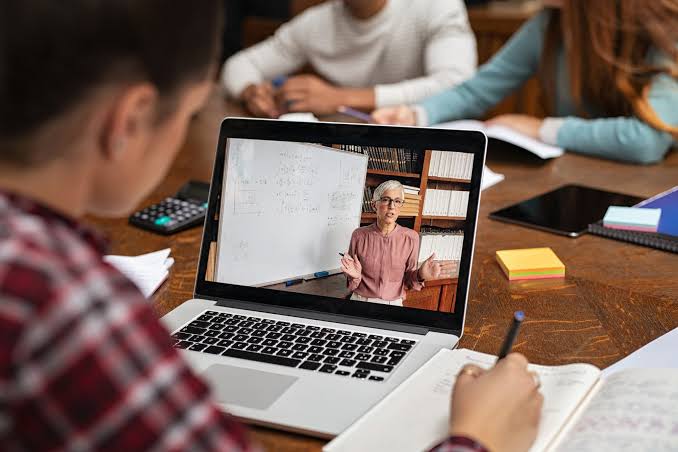
Before 2020, most people thought online learning was just a backup plan. Then the pandemic changed everything. Millions of students attended school from their bedrooms. Now, years later, online learning is here to stay. But what will it look like in the future? Will artificial intelligence replace human teachers? Will students ever return to physical classrooms full time? The future of education is being rewritten right now.
📖 Level 1 - Beginner:
Online learning means studying on a computer. During the pandemic, many students learned from home. Now some schools still offer online classes. In the future, more students may learn online. Artificial intelligence (AI) could help teach. A computer might give you math problems just for you. It could explain things you do not understand. But AI cannot hug you. It cannot see if you are sad. Human teachers are still important. The best future might mix online and in-person learning. You watch a lesson at home. Then you go to school to ask questions and play with friends.
📖 Level 2 – Intermediate:
The COVID-19 pandemic forced the largest remote learning experiment in history. Almost overnight, 1.6 billion students switched to online learning. Many struggled. But some thrived. Now, years later, online learning has permanently changed education. Universities like Harvard and MIT offer free online courses through platforms like edX and Coursera. Entire degree programs are now available fully online. So what comes next? Artificial intelligence is the biggest game-changer. AI tutors can provide personalized instruction, adapting to each student's pace and learning style. An AI system might notice that you struggle with fractions but excel at geometry — and adjust lessons
automatically. AI can also grade assignments, answer basic questions, and even generate practice problems. However, AI has limits. It cannot provide emotional support, recognize signs of abuse or depression, or inspire passion the way a great human teacher can. The future is likely hybrid: students watch AI-powered lectures at home, then attend school for discussion,
collaboration, and hands-on activities. Physical classrooms will not disappear. But their purpose will change. They will become places for connection, not just information delivery. The schools that succeed will be the ones that use technology to enhance — not replace — human relationships.
📖 Level 3 – Advanced:
The shift to online learning during 2020–2021 was neither planned nor gradual. It was a forced, global acceleration of trends already in motion. Prior to the pandemic, only 30% of US college students had taken an online course. By April 2020, virtually 100% of learners in affected countries were remote. The results were uneven: students in affluent homes with reliable internet, quiet spaces, and educated parents often performed as well or better than in-person. Low-income students, those with disabilities, and English language learners fell significantly behind — a phenomenon termed the "COVID slide" or "learning loss." Now, as emergency remote teaching has matured into strategic online learning, three trajectories are emerging. First, the massive open online course (MOOC) model has evolved into credential-bearing micro-degrees and professional certificates. Platforms like Coursera, edX, and Udacity now partner with industry (Google, IBM, Microsoft) to offer job-ready credentials that cost a fraction of traditional degrees. Second, artificial intelligence is enabling adaptive learning systems (e.g., Carnegie Learning's MATHia, Duolingo's AI-driven language instruction) that provide real-time differentiation impossible in a classroom of 30 students. These systems identify knowledge gaps, predict forgetting curves, and personalize review schedules. Third, virtual and augmented reality (VR/AR) promise immersive experiential learning: medical students practicing surgery, history students walking through ancient Rome, chemistry students mixing compounds without explosion risk. However, critical limitations remain. The "digital divide" persists: an estimated 35% of global households lack internet access. Social isolation during remote learning has been linked to increased anxiety, depression, and loneliness among adolescents. And AI, for all its
sophistication, cannot yet replicate the empathetic, intuitive, and improvisational capacities of a master teacher. The future is not a choice between online and in-person — it is a synthesis. The most effective models will be hybrid or blended learning: asynchronous content delivery (video lectures, interactive modules) combined with synchronous, in-person or live-online sessions for discussion, project-based learning, and social-emotional development. Physical schools will not disappear. But their role will shift from information transmission (which computers do efficiently) to community building (which only humans can do). The institutions that thrive will treat technology as a tool, not a replacement. The goal is not classrooms without walls or teachers without jobs. The goal is better learning for more people at lower cost — with humanity intact.

Comments (0)
Comments are published after admin approval.
No approved comments yet. Be the first to comment.