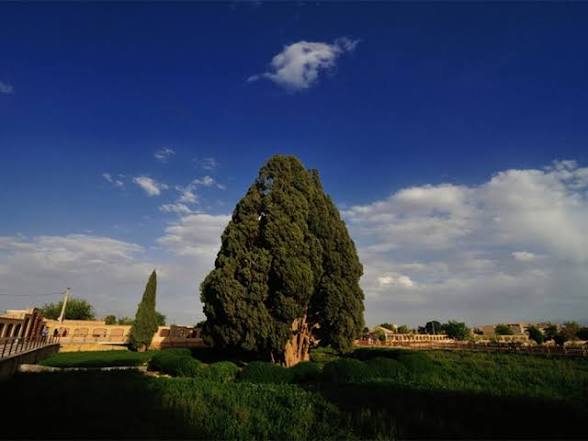
Iran has a very old tree. It is called Sarv-e Abarkuh. It is a cypress tree. The tree is 4,500 years old. It lives in Yazd province. The tree is 25 meters tall. It is green all year. People believe a prophet planted it. The tree is a national monument. It is one of the oldest living things in the world. Tourists come to see this amazing tree.
📖 Level 2 – Intermediate:
Iran is home to one of the world's oldest living organisms: the Sarv-e Abarkuh, also known as the "Zoroastrian Sarv." This majestic Mediterranean cypress tree (Cupressus sempervirens) is located in the city of Abarkuh in Yazd Province. Estimated to be between 4,000 and 4,500 years old, it is widely considered the oldest living thing in Asia and the second oldest in the world.
Standing approximately 25 meters (82 feet) tall, its trunk has a circumference of 11.5 meters (nearly 38 feet). It is a protected national natural monument of Iran. Local legend says the tree was planted by Zoroaster, the ancient prophet, or by Japheth, the son of Noah. For centuries, it has been a symbol of life, resilience, and Iran's rich cultural heritage.
📖 Level 3 – Advanced:
Standing sentinel in the city of Abarkuh in Iran's Yazd Province is the Sarv-e Abarkuh, a monumental Mediterranean cypress (Cupressus sempervirens). This tree is not merely old; it is a living relic, with scientific consensus placing its age between 4,000 and 4,500 years. Some Russian and Japanese researchers have proposed estimates as high as 5,500 to 8,000 years, which would make it the oldest in the world. Regardless, it is widely considered the oldest living lifeform in Asia and is a peer of the ancient Egyptian pyramids.
Soaring to a height of 25 meters (about 82 feet), the tree boasts a remarkable trunk circumference of 11.5 meters. As a testament to its significance, it is inscribed on Iran's National Heritage List. The legendary origins of the Sarv-e Abarkuh are deeply embedded in Persian culture; one tale claims the prophet Zoroaster planted it himself, while another attributes it to Japheth, son of Noah. Its evergreen nature made it sacred to Zoroastrians and a central feature of Persian garden design. Designated a national natural monument, it continues to be a powerful symbol of endurance, a silent witness to millennia of human history.
Newsletter
Get new articles by email
Level-appropriate English news when we publish. Free, no spam.
New stories
Free
Unsubscribe anytime
Comments (0)
Comments are published after admin approval.
No approved comments yet. Be the first to comment.

Comments (0)
Comments are published after admin approval.
No approved comments yet. Be the first to comment.