
The Persian Ice Houses That Made Ice in the Desert

The Persian Ice Houses That Made Ice in the Desert banner
📖 Level 1 - Beginner:

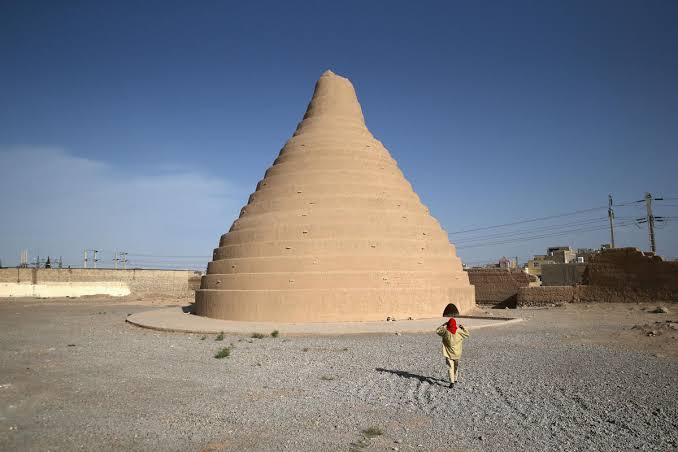
Long ago in the Persian desert, people needed ice. But deserts are very hot. How did they make ice? They built special buildings called yakhchals. Yakhchal means "ice pit." The buildings were made of mud and clay. They were very tall. They had thick walls. Water flowed into a pool at night. The desert nights were cold. The water froze. People stored the ice inside the yakhchal. The ice lasted all summer. They did this 2,000 years ago. No electricity. No freezer. Just smart design.

📖 Level 2 – Intermediate:

In the hot, dry deserts of ancient Persia, having ice in summer was not a dream—it was a reality. Persian engineers invented a remarkable structure called the yakhchal, which means "ice pit" in Persian. These buildings were dome-shaped and made from a special mortar called sarooj, a mixture of clay, sand, egg whites, and goat hair. The sarooj was waterproof and insulated heat very well. The yakhchal had thick walls, sometimes up to two meters thick. It also had a tall, cone-shaped roof and a deep underground pit. How did it make ice? During winter, water from nearby mountains was channeled into shallow pools next to the yakhchal. On cold desert nights, the water froze because temperatures in the desert drop significantly after sunset. Workers collected the ice and moved it into the underground pit of the yakhchal. The thick walls and underground location kept the ice cool throughout the hot summer months. The tall dome helped hot air rise and escape through small holes at the top. Some yakhchals also had windcatchers (badgirs) to pull cool air down. The ice was used for chilled drinks, making faloodeh (a famous Persian frozen dessert), and preserving food. The oldest yakhchals date back over 2,000 years. They are considered one of the world's first refrigerators.

📖 Level 3 – Advanced:

Before the invention of electric refrigeration, the inhabitants of ancient Persia solved a seemingly impossible problem: how to create and store ice in one of the hottest, driest environments on Earth. Their solution was the yakhchal (یخچال), or "ice pit"—a masterpiece of passive cooling engineering that dates back to around 400 BCE. The yakhchal was not a single feature but a system. Its key components included: 1. A thick-walled, dome-shaped structure built from sarooj, a proprietary waterproof mortar made of clay, sand, lime, egg whites, and sometimes goat hair. Sarooj was highly resistant to heat transfer and water penetration. Walls could be up to two meters thick. 2. A deep underground storage pit (often 5–6 meters deep) where ice was packed. The ground temperature remained consistently cool, often below 10°C (50°F), year-round. 3. A tall conical roof (sometimes up to 20 meters high) with small ventilation openings at the top. The shape encouraged any warm air entering the structure to rise and escape, creating a passive draft that drew cooler air downward into the pit. 4. Ice-making pools and qanats (underground water channels). During winter months, water was diverted into shallow, shadowed pools adjacent to the yakhchal. On cloudless desert nights, radiative cooling could drop temperatures below freezing even when daytime highs exceeded 30°C (86°F). The water froze by morning. Workers then broke the ice into blocks and transferred them to the underground pit, sometimes layering straw or fabric between blocks for insulation. Some larger yakhchals could store ice well into the summer months, with losses of only about one-third of the total mass by August. The ice was used to make faloodeh (a rosewater and vermicelli frozen dessert, still popular today), chill beverages for wealthy households and mosques, and preserve meats and dairy. Many yakhchals also incorporated badgirs (windcatchers) to enhance airflow. Dozens of yakhchals still stand across Iran, from the central deserts around Yazd to the plains of Kerman. They are recognized by UNESCO as part of the Persian Qanat system's cultural landscape—a testament to a civilization that, two millennia ago, refused to accept the desert's limits. While modern freezers have replaced them, the yakhchal remains a stunning example of sustainable, passive climate control. And somewhere in Yazd, a 1,500-year-old dome still stands, waiting for a cold night and a little water to make ice once more.

📚 Vocabulary

Words from this article that appear in our vocabulary books.

Word Definition
About a bit more or a bit less
Adjacent nearby: neighboring;a room, building, piece of land etc that is ~ to something is next to it
Air feeling
Ancient antique: old- belonging to a long time in old history
Broke having no money
Central essential, more important and having more influence than anything else
Climate the normal weather conditions of a particular region
Consistently regularly, uniformly
Create invent, manufacture
Cultural something related to art, literature, music, etc
Deep long way down
Design create, draw, plan
Dream a ​series of ​events or ​images that ​happen in ​your ​mind when you are ​sleeping
Drop decrease; go lower (SYN fall)
During at a point of within a period of time
Earth our planet
Engineering the activity of designing roads, railways, bridges, etc
Enhance improve: intensify
Even at the same level
Fabric cloth or ​material for making ​clothes, ​covering ​furniture, etc. (SYN material)
Feature an important part of sth, and often a part that you notice
Goat an ​animal ​related to ​sheep that usually has ​horns and a ​beard
Ground reason, cause
Hair the ​mass of ​thin thread-like ​structures on the ​head of a ​person
Intermediate in-between
Invention something that has never been made before
Key significant: critical, of paramount or crucial importance
Landscape scenery, a large area of countryside,a view or picture of the countryside, or the art of making such pictures
Masterpiece a great work of art
Means ways # methods
Mud soft, wet earth
One 1
Part some but not all of a thing
Pool place to do swimming
Popular liked by most people
Preserve keep away from harm or change; keep safe; protect
Remains parts of objects and buildings that have been discovered recently
Remarkable 1)notable 2)incredible
Rise emerge
Roof the ​covering that ​forms the ​top of a ​building
Round shaped like a ​ball or ​circle, or ​curved
Sand very ​small ​grains of ​rock
Shallow not deep
Shape the ​particular ​physical ​form or ​appearance of something
Solution answer to a problem
Storage a place to store things
Stunning astounding
Sustainable adj) endurable
Thick (inf) stupid
Through by
Throughout during the period
Top the highest place or part
Transfer move
Two 2
Walled surrounded by walls
Wealthy rich (SYN well off)
While although

Comments (0)

Comments are published after admin approval.

No approved comments yet. Be the first to comment.

Stay updated

Get notified when we publish a new article.