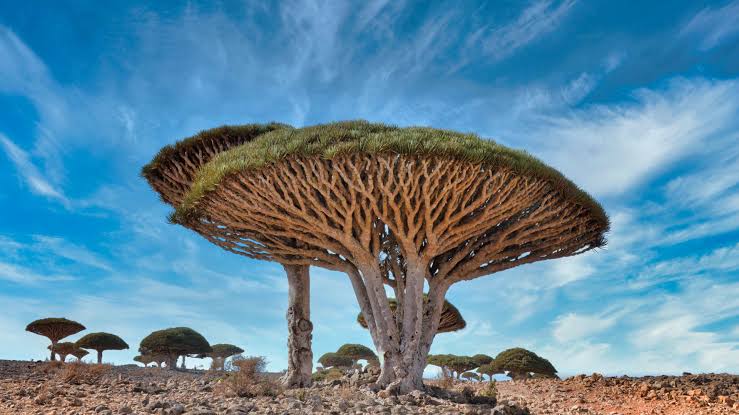
There is a special tree. It grows on an island in Africa. The tree is called the dragon's blood tree. Its sap is red. The red sap looks like blood. People call the tree "bleeding." The sap is used as medicine. It can stop bleeding. It can help sick people. The tree looks like an umbrella. Its branches go up and then out. The tree lives for hundreds of years. It is very strange and beautiful.
📖 Level 2 – Intermediate:
On the island of Socotra, near Yemen in the Indian Ocean, grows one of the strangest trees on Earth. Its name is the dragon's blood tree (Dracaena cinnabari). When you cut its bark, a thick, dark red liquid drips out. This liquid looks exactly like blood. That is why ancient people believed the tree was a wounded dragon. The red sap was called "dragon's blood." The tree's shape is also unusual. Its branches grow upward and then spread out like a giant umbrella. This shape helps the tree collect water from fog in the dry desert climate. The sap has been used for thousands of years as medicine, red dye, and even varnish for violins. Today, the dragon's blood tree is endangered because of climate change and overuse. But it remains one of nature's most magical sights—a bleeding tree in a faraway island paradise.
📖 Level 3 – Advanced:
Deep in the Indian Ocean, the remote archipelago of Socotra (often called the "Galapagos of the Indian Ocean") harbors a botanical marvel that seems pulled from mythology: the dragon's blood tree, Dracaena cinnabari. This ancient species, a relic of the Mio-Pleistocene era, possesses a crown of densely packed, upward-growing branches that form a perfect, umbrella-like canopy. This distinctive morphology, known as a "reverse hydrologic system," allows the tree to capture moisture from passing fog and channel it down to its roots—an essential adaptation to Socotra's arid, monsoon-driven climate.
But the tree's most legendary feature is its sap. When the bark is cut or damaged, a deep crimson resin exudes from the wound, strikingly reminiscent of blood. This resin, commercially known as "dragon's blood," has been traded for over 2,000 years. Ancient Romans, Greeks, and Arabs prized it as a panacea: they used it to stop bleeding, heal wounds, treat diarrhea, and even as a red dye for cosmetics and early photographic emulsions. In medieval times, Italian violin makers used it as a varnish. Today, scientists are investigating its potential antimicrobial and wound-healing properties. Unfortunately, the dragon's blood tree is now classified as vulnerable to extinction. Climate change has reduced fog cover on Socotra, and the tree's natural regeneration has slowed dramatically. Conservation efforts are underway, but for now, this bleeding giant remains one of nature's most haunting and beautiful oddities—a living fossil that bleeds like a wounded animal, standing alone on an island lost in time.
Newsletter
Get new articles by email
Level-appropriate English news when we publish. Free, no spam.
New stories
Free
Unsubscribe anytime
Comments (0)
Comments are published after admin approval.
No approved comments yet. Be the first to comment.

Comments (0)
Comments are published after admin approval.
No approved comments yet. Be the first to comment.