
Tombs That Touched the Sky

Tombs That Touched the Sky banner
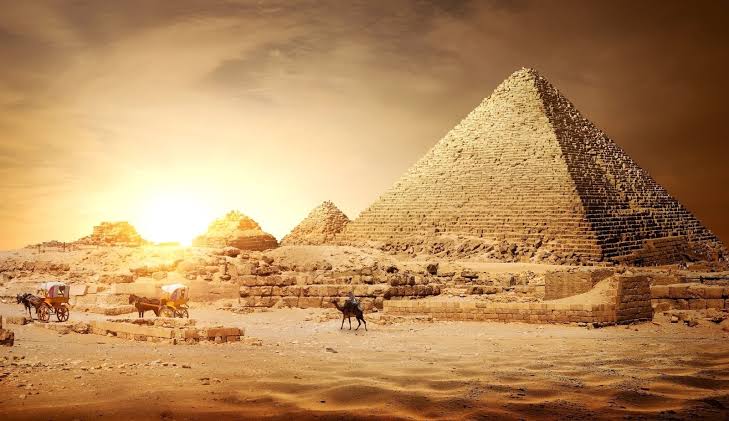
The Egyptian pyramids, especially the Great Pyramid of Giza, were built as tombs for pharaohs around 4,500 years ago. Thousands of workers cut, moved, and stacked massive limestone blocks without modern machines. They used ramps, sledges, and sheer human strength. The pyramids show incredible planning and teamwork. How exactly they did it remains partly a mystery.

📖 Level 1 - Beginner:

The pyramids are giant stone tombs in Egypt. They were built for pharaohs. Pharaohs were like kings. People believed pharaohs became gods after death. The pyramids helped them go to heaven. The biggest pyramid is the Great Pyramid of Giza. It was built for Pharaoh Khufu. It took about 20 years to finish. Workers used huge stones. Each stone weighed as much as a car. There were no machines. No cranes. No trucks. Workers cut stones with copper tools. They moved stones on wooden sledges. They pulled the sledges on wet sand. Wet sand made it slippery. Workers also built ramps. They pulled stones up the ramps. About 20,000 to 30,000 workers lived nearby. They were not slaves. They were skilled workers. They ate well and received medical care. The pyramids are still standing today. They are the only ancient wonder still alive. We still do not know every secret. But we know the builders were amazing.

📖 Level 2 – Intermediate:

The pyramids of Egypt, particularly the Great Pyramid of Giza, rank among the most extraordinary human achievements. Built around 2560 BCE during the Fourth Dynasty, they served as tombs for pharaohs, who were considered living gods. The largest, for Pharaoh Khufu, originally stood 146 meters tall and contained over 2.3 million limestone blocks, each weighing 2.5 to 15 tons. Workers cut the stone using copper chisels and dolerite hammers. They transported blocks on wooden sledges, likely pulled by teams of 20 to 40 men. Recent research suggests workers wet the sand in front of the sledge to reduce friction. To raise blocks up the growing pyramid, builders constructed massive ramps — straight, zigzagging, or spiraling around the structure. No one knows exactly which ramp design they used. The workforce was not enslaved Hebrew laborers (a common myth). Instead, archaeological evidence shows a paid, well-fed crew of skilled Egyptian workers, organized into teams with nicknames like “Friends of Khufu.” They lived in a nearby workers’ town with bakeries, breweries, and medical care. The pyramids required incredible logistics but no modern machines. Their survival for over 4,500 years proves the skill of ancient engineers.

📖 Level 3 – Advanced:

The construction of the Egyptian pyramids, especially the Great Pyramid of Giza, remains a subject of awe and debate. Built during the Old Kingdom’s Fourth Dynasty (c. 2580–2560 BCE), these monuments were royal tombs designed to ensure a pharaoh’s resurrection. The Great Pyramid, attributed to Pharaoh Khufu, originally reached 146.6 meters (now 138.5 meters due to erosion) and contained approximately 2.3 million blocks of local limestone, plus granite from Aswan, 800 kilometers away. Quarrying involved pounding dolerite balls into the stone to create fissures, then inserting wooden wedges that were soaked with water to expand and crack the rock. Transport relied on wooden sledges; experiments show that wetting desert sand dramatically reduces friction, allowing a sledge to be pulled by half the usual number of workers. Ramps were essential for raising blocks. Archaeologists debate the ramp type — straight, linear, L‑shaped, or spiral around the pyramid — because no ramp has survived. Workforces numbered 20,000–30,000, not slaves but skilled laborers conscripted from across Egypt during the Nile flood season when farming was impossible. They lived in a purpose‑built city with bakeries, copper workshops, and a hospital. The precision is astonishing: the pyramid’s base is level within 2 centimeters, and the sides align to true north within 1/15th of a degree. While many mysteries remain (how they achieved such precision without modern tools), the pyramids stand as a testament to human ingenuity, social organization, and the power of collective belief.

📚 Vocabulary

Words from this article that appear in our vocabulary books.

Word Definition
About a bit more or a bit less
Alive being live
Amazing remarkable
Ancient antique: old- belonging to a long time in old history
Approximately roughly-more or less than a number or amount
Astonishing amazing,astoundingly
City a large town
Construction the way words are used together in sentence
Crack a weakness in an idea, a system, or an organization
Create invent, manufacture
Cut an ​injury made when the ​skin is cut with something ​sharp
Debate a discussion in which reasons for and against something are brought out
Degree extent, measure
Design create, draw, plan
Dramatically noticeably: greatly
Due expected to arrive or happen
During at a point of within a period of time
Ensure guarantee
Essential necessary; very important
Evidence that which makes clear the truth or falsehood of something
Expand increase in size; enlarge; swell
Extraordinary exceptional, phenomenal
Flood to cause to fill or become covered with water
Friction conflict, disagreement, tension
Giant huge,extremely big, and much bigger than other things of the same type
Growing increasing in size, amount, or degree
Half either of the two ​equal or ​nearly ​equal ​parts that together make up a ​whole
Hospital a ​place where ​people who are ​ill or ​injured are ​treated and taken ​care of by ​doctors and ​nurses
Huge large, enormous, colossal, massive
Human connected with people
Incredible very unusual or much better than usual SYN extraordinary
Ingenuity cleverness: creativeness: inventiveness: resourcefulness
Intermediate in-between
Like used to introduce an example (SYN such as)
Living not dead
Local located in the area where you live
Massive big and heavy; large and solid; bulky
Mystery a story in which the events are only explained at the end
Myth an invented story or idea # legend
Originally at the first
Particularly especially
Partly in some degree
Planning the act or process of making plans for sth
Precision accuracy
Recent done, made, or occurring not long ago
Remains parts of objects and buildings that have been discovered recently
Royal relating to a king or queen
Sand very ​small ​grains of ​rock
Sheer absolute
Skilled having the ability and experience to do sth well (SYN expert)
Soaked become extremely wet
Stone the hard, ​solid ​substance ​found in the ​ground that is often used for ​building, or a ​piece of this
Straight continuing in one ​direction without ​bending or ​curving
Tools a ​piece of ​equipment that you use with ​your ​hands to make or ​repair something
Transport to move from one place to another # carry
While although
Within inside
Wonder ask yourself questions about sth

Comments (0)

Comments are published after admin approval.

No approved comments yet. Be the first to comment.

Stay updated

Get notified when we publish a new article.