The internet began as a small US military project called ARPANET in the 1960s. It grew into a global network connecting billions of devices. Key steps included the creation of email, the World Wide Web in 1991, broadband, smartphones, and now the Internet of Things. From screeching dial‑up sounds to instant streaming, the internet has changed how we live, work, and love.
📖 Level 1 - Beginner:
The internet is not very old. It started in the 1960s. Only a few computers talked to each other. Scientists wanted to share information. In 1971, the first email was sent. People were excited. But the internet was hard to use. In 1991, the World Wide Web was born. Now you could click on links. Websites had pictures and words. In the 1990s, you used dial‑up. You heard a loud screeching sound. It was very slow. A picture took one minute to load. Then came broadband. The screeching stopped. Internet became fast. Smartphones brought internet everywhere. You could go online on the bus. Now we have smart homes. Your fridge can talk to your phone. The internet is in everything. What will come next? Nobody knows. But the internet will keep changing. From one small room of computers to the whole world — that is the internet’s story.
📖 Level 2 – Intermediate:
The internet’s evolution is one of the fastest technological shifts in history. It began in 1969 as ARPANET, a four‑computer network funded by the US Department of Defense. The goal was to create a system that could survive a nuclear attack. By 1971, email was invented, and the “@” symbol became famous. For years, only researchers and the military used the internet. Everything changed in 1991 when Tim Berners‑Lee introduced the World Wide Web. He made websites easy to visit with a browser. The 1990s brought dial‑up connections. Users heard a memorable screech as their modem connected. Speeds were painfully slow — 56 kilobits per second. A song could take an hour to download. Early 2000s broadband replaced dial‑up. Faster speeds allowed video streaming, online gaming, and social media. Then smartphones (iPhone 2007) put the internet in everyone’s pocket. Today, we have the Internet of Things (IoT): watches, fridges, and cars all online. The next frontier includes artificial intelligence and satellite internet from space. From a defense project to a human necessity, the internet keeps reinventing itself.
📖 Level 3 – Advanced:
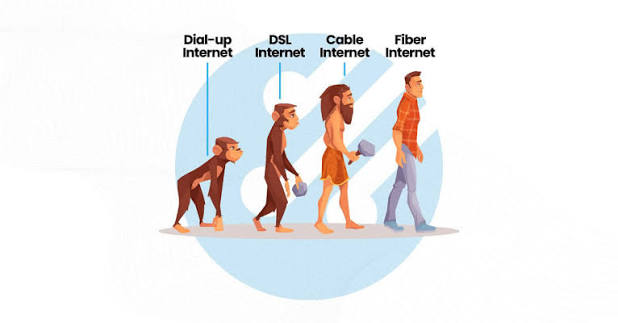
The internet’s evolution from a niche research tool to a global utility spans just over five decades. Its origin lies in ARPANET (1969), commissioned by the US Advanced Research Projects Agency. The network employed packet switching — breaking data into small packets that could take different routes — ensuring resilience. In 1971, Ray Tomlinson sent the first email, choosing the “@” symbol to separate user from machine. The 1980s saw the adoption of TCP/IP protocols, creating a true “network of networks.” However, the internet remained text‑based and arcane until 1991, when Tim Berners‑Lee launched the World Wide Web, introducing URLs, HTML, and the first browser. The mid‑1990s brought commercialization: dial‑up modems (max 56 kbps) screeched into homes, though browsing was slow and tied up phone lines. Broadband (early 2000s) liberated the phone line and enabled streaming, peer‑to‑peer sharing, and YouTube. The smartphone revolution (2007 iPhone) made internet connectivity constant and location‑aware, spawning apps, ride‑sharing, and social media. The 2010s saw the Internet of Things (IoT) embed connectivity into everyday objects. Today, 5G promises low‑latency connectivity for autonomous vehicles, while projects like Starlink aim to erase rural dead zones. The next era involves decentralizing the internet via blockchain and integrating AI. What began as a military contingency is now woven into consciousness. The internet has no finish line — only new protocols.
Newsletter
Get new articles by email
Level-appropriate English news when we publish. Free, no spam.
New stories
Free
Unsubscribe anytime
📚 Vocabulary
Words from this article that appear in our vocabulary books.
Word
Definition
Agency
a business or government department that provides a particular service
Aim
a thing you want to be able to do in the future (SYN goal)
Arcane
—
Autonomous
by itself; with no association # independent
Aware
knowing; realizing
Based
when sth is the centre for your work
Can
used with see, smell or taste in the continuous tense
Constant
stable, fixed, firm
Contingency
sth that may or may not happen. e.g. contingency plan/fund
Create
invent, manufacture
Data
facts; information
Department
a section of a business, university, etc
Embed
enclose: implant: insert
Era
period
Everyday
normal or usual
Goal
a thing you want to be able to do in the future (SYN aim)
However
yet, but
Human
connected with people
Instant
[adjective]: immediate [noun]: a moment
Intermediate
in-between
Keep
continue or stay ina particular place or condition
Key
significant: critical, of paramount or crucial importance
Like
used to introduce an example (SYN such as)
Live
seen or heard as it is happening
Loud
making a lot of noise
Military
connected with soldiers, or the army, navy, and air force
Minute
very small: tiny, minuscule, miniature
Network
a system of roads, lines, wires, etc. that are connected to each other. railroad/underground/network/network)
Origin
the cause of sth, or the place where it starts to exist
Per
for each
Resilience
the capacity to recover quickly from difficulties; toughness. also flexibility, elasticity
Revolution
dramatic change
Rural
in the country
Satellite
an object that moves round a bigger object in space; a piece of electronic equipment that is sent into space and moves around
Screech
a loud, high, unpleasant sound. like car brakes
Separate
different
Share
a part of sth that has been divided
Space
the area beyond the earth round the planets and stars
Survive
live longer than; remain alive after
Take
require
Text
the written part of the book, newspaper, etc
Via
by means of: by the way of
While
although
Whole
entire
Wide
having a large distance from one side to another
Work
get or have the result you want
Comments (0)
Comments are published after admin approval.
No approved comments yet. Be the first to comment.

Comments (0)
Comments are published after admin approval.
No approved comments yet. Be the first to comment.