There is a strange flower. It looks like meat. It smells like dead animals. Flies think it is food. They land on the flower. But there is no food. The flower puts pollen on the fly. The fly flies away. It lands on another flower. The pollen comes off. The flower used the fly as a mailman. The fly never gets paid. The flower does this every time. Smart plant.
📖 Level 2 – Intermediate:
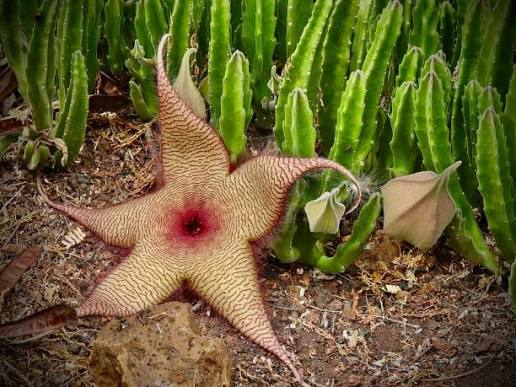
Deep in the forests of South Africa and Australia, there lives a sneaky plant called the carrion flower. It belongs to the genus Stapelia and related plants like Ceropegia. This flower does not want bees or butterflies. It wants flies. To attract flies, the carrion flower looks and smells like rotting meat. Its petals are hairy, reddish-brown, and covered in spots that look like decay. The smell is even more convincing—like dead animals or old garbage. Flies love dead things. They land on the flower expecting food or a place to lay eggs. But there is no meat. Instead, the flower attaches tiny packets of pollen to the fly's body. The fly, confused and hungry, flies away. It eventually lands on another carrion flower. The pollen transfers. The second flower is now fertilized. The fly gets nothing except a wasted trip. Botanists call this "deceptive pollination." The flower tricks flies into becoming mail carriers for free. No nectar. No reward. Just lies and reproduction.
📖 Level 3 – Advanced:
In the evolutionary arms race between plants and pollinators, most flowers offer a reward: nectar, shelter, or heat. But some plants have discovered a cheaper strategy—deception. Enter the carrion flowers, primarily in the genera Stapelia, Orbea, and Hoodia (family Apocynaceae). Native to the arid regions of southern Africa, these succulents produce flowers that mimic carrion in every conceivable way. Their petals are fleshy, wrinkled, and colored in mottled shades of maroon, purple, and tan. Many possess fine hairs that quiver in the slightest breeze, resembling fungal growth on rotting flesh. The olfactory illusion is even more sophisticated: they emit volatile organic compounds including putrescine and cadaverine—the exact chemicals that give decomposing meat its signature stench.
Flower flies (family Calliphoridae) and flesh flies (Sarcophagidae) detect these odors from kilometers away. They arrive expecting an oviposition site (a place to lay eggs) or a protein-rich meal. They land, crawl over the flower's corona, and find... nothing. No rotting flesh. No maggots. No food. But during their frustrated search, the flower's pollinaria (packets of pollen attached to a sticky disc) adhere to the fly's legs or proboscis. The fly departs, cheated but still carrying pollen. When it inevitably falls for the same trick on another carrion flower, the pollen is deposited, and cross-pollination occurs. The fly receives zero benefit. This system, known as "brood-site deception," is evolutionarily stable only because fly populations remain abundant and their memories short. The carrion flower has solved the problem of reproduction not through cooperation, but through clever, fragrant fraud. It is nature's perfect con artist—in floral form.
Newsletter
Get new articles by email
Level-appropriate English news when we publish. Free, no spam.
New stories
Free
Unsubscribe anytime
Comments (0)
Comments are published after admin approval.
No approved comments yet. Be the first to comment.

Comments (0)
Comments are published after admin approval.
No approved comments yet. Be the first to comment.