In Australia, some birds use fire to hunt. They are called firehawks. They pick up burning sticks from wildfires. They drop the sticks into dry grass far away. This starts a new fire. Small animals run away from the fire. The birds catch and eat them. Only three kinds of birds do this. Scientists did not believe it at first. But now they have proof. These birds are the only animals that make fire.
📖 Level 2 – Intermediate:
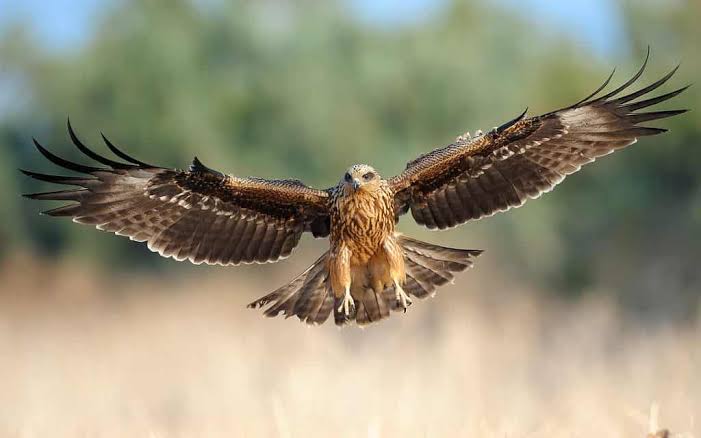
In northern Australia, a group of birds known as "firehawks" have learned a remarkable skill. The species include the black kite, the whistling kite, and the brown falcon. During the dry season, wildfires often start naturally. Firehawks pick up burning twigs or grass in their beaks or talons. They then carry these flaming sticks to unburned areas and drop them. The new fire flushes out insects, lizards, frogs, and small mammals. The birds then swoop in to catch their fleeing prey. Aboriginal Australians have known about this behavior for thousands of years. Western scientists, however, were skeptical until recent studies confirmed it. The firehawks do not start fires from scratch. They spread existing fires on purpose. This makes them the only non-human animals known to use fire as a tool for hunting.
📖 Level 3 – Advanced:
Fire is widely considered a uniquely human invention — but the firehawks of northern Australia challenge that assumption. The black kite (Milvus migrans), whistling kite (Haliastur sphenurus), and brown falcon (Falco berigora) have been observed by ethologists engaging in a behavior called "fire-foraging." During the savanna dry season, when lightning strikes and human activity ignite wildfires, these raptors deliberately pick up smoldering sticks or grass from active fire fronts. Using their beaks or talons, they transport these burning embers to adjacent, unburned grasslands and release them. The resulting spot fire drives out a panicked escape of prey — insects, small reptiles, rodents, and amphibians — which the birds then capture with ease. Aboriginal Australian oral traditions have described this behavior for millennia, but Western ornithology dismissed it as anecdotal until a 2017 study published in the Journal of Ethnobiology documented over 20 verified observations. While the birds do not create fire de novo, their intentional transport and deployment of burning material constitutes a form of fire use. This places them in an elite category previously reserved for humans. The firehawk does not fear fire. It wields it — a winged predator turning nature's most destructive force into a dinner bell.
Newsletter
Get new articles by email
Level-appropriate English news when we publish. Free, no spam.
New stories
Free
Unsubscribe anytime
Comments (0)
Comments are published after admin approval.
No approved comments yet. Be the first to comment.

Comments (0)
Comments are published after admin approval.
No approved comments yet. Be the first to comment.