
The Island Where Coconuts Kill More Than Sharks

The Island Where Coconuts Kill More Than Sharks banner
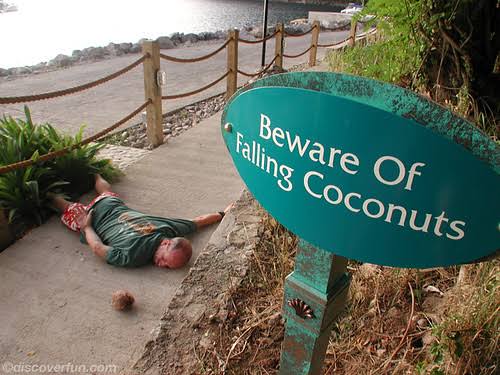
📖 Level 1 - Beginner:

Coconuts look harmless. But they can be dangerous. On some islands, falling coconuts kill people every year. Sharks kill only a few people. Coconuts kill more. A coconut can fall from 25 meters high. It weighs up to 1.5 kilograms. It can hurt your head badly. Experts say coconuts kill about 150 people each year. Sharks kill about 10. So coconuts are 15 times more dangerous. Be careful under coconut trees.

📖 Level 2 – Intermediate:

When people think of dangers at the beach, they often worry about sharks. But there is a hidden danger that falls from above: coconuts. A ripe coconut can weigh up to 1.5 kilograms (about 3.3 pounds). It can fall from a height of 25 meters (82 feet). The impact can be deadly. According to various studies, falling coconuts kill approximately 150 people worldwide each year. In contrast, sharks kill around 10 people annually. This means you are 15 times more likely to be killed by a coconut than by a shark. Certain tropical islands have posted warning signs near coconut trees. Some resorts even remove coconuts before they fall. The most famous case happened in Papua New Guinea and other South Pacific islands. Of course, the risk is still very low. But the next time you relax under a palm tree, look up first. That coconut is not your friend.

📖 Level 3 – Advanced:

The idyllic image of a tropical beach often includes leaning palm trees laden with coconuts. What postcards do not show is the quiet danger hanging overhead. The coconut palm (Cocos nucifera) produces fruits weighing between 1 to 2.5 kilograms. When ripe, they fall from heights reaching 25 to 30 meters, achieving speeds of up to 80 kilometers per hour upon impact. Force calculations put the impact energy at roughly 1,000 joules — comparable to a small car crash. According to data compiled from medical records and news reports, fatal coconut strikes occur at an estimated rate of 150 per year globally. By comparison, the International Shark Attack File reports approximately 10 fatal shark attacks annually. The disparity has given rise to the often-cited statistic that coconuts kill 15 times more people than sharks. Notable cases include a fatal strike in Queensland, Australia (2002) and multiple incidents in Papua New Guinea and Vanuatu. While the risk per individual remains minuscule — one in several million — the comparison serves as a powerful reminder that nature's most innocuous-looking features can be surprisingly lethal. Tourists are now advised not to sleep or sit directly under coconut palms. And shark? They get an undeserved reputation. The real danger, it turns out, has been above our heads all along.

📚 Vocabulary

Words from this article that appear in our vocabulary books.

Word Definition
About a bit more or a bit less
Annually yearly-once a year- ever year
Approximately roughly-more or less than a number or amount
Beach an ​area of ​sand or ​small ​stones near the ​sea or another ​area of ​water such as a ​lake
Can used with see, smell or taste in the continuous tense
Certain specified, determined, definite, opposite of undefined & nameless & general
Comparable equivalent, similar to something so that we can make a comparison
Data facts; information
Disparity
Energy the ability to be very active without getting tired
Even at the same level
Fall decrease; go lower (SYN drop)
Given particular, previously arranged, specified
Harmless not causing damage, injury, or illness
Include to have something as a part (SYN contain)
Individual one person who is seen separately from others or a group
Innocuous
Intermediate in-between
International involving two or more countries
Lethal deadly: fateful, fatal
Look turn your eyes to sth and pay attention to it; seem from what you can see
Means ways # methods
Minuscule extremely small, tiny, miniature
Notable important: outstanding
Occur happen, especially in a way that has not been planned
One 1
Per for each
Rate classify, consider to be of a certain quality, standard, or rank.
Remains parts of objects and buildings that have been discovered recently
Reputation fame
Rise emerge
Risk danger
Roughly almost: approximately
Say the right to take part in deciding sth (give sb a say/have a say in sth)
Several more than two, but not many
Shark a ​large ​fish that has ​sharp ​teeth and a ​pointed fin on ​its back
Sleep the ​resting ​state in which the ​body is not ​active and the ​mind is ​unconscious
Strike come into: contract with
Warning information that sth bad my happen
Weigh have a certain weight; process of weight measurement
While although
Worldwide existing or happening in all parts of the world

Comments (0)

Comments are published after admin approval.

No approved comments yet. Be the first to comment.

Stay updated

Get notified when we publish a new article.