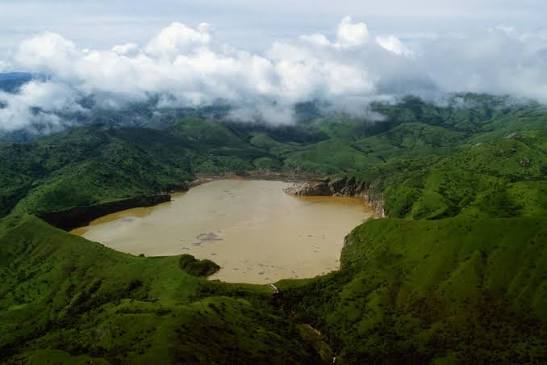
In Africa, there are three dangerous lakes. They look normal. But under the water, there is hidden gas. The gas can explode. One night in 1986, a lake exploded. A huge cloud of gas came out. People and animals could not breathe. Over 1,700 people died. The lake is called Lake Nyos. Scientists now put pipes in the lake. The pipes let out gas slowly. The lake is safer now.
📖 Level 2 – Intermediate:
Deep in Cameroon, West Africa, there is a beautiful lake called Lake Nyos. But beauty hides danger. The lake sits on top of a volcano. Magma below the lake releases carbon dioxide gas. The gas dissolves into the water. This is normally safe. But in 1986, something terrible happened. A landslide triggered the lake. The gas suddenly burst out like a shaken soda bottle. A huge invisible cloud of carbon dioxide rushed across nearby villages. Carbon dioxide is heavier than air. The cloud stayed close to the ground. People and animals could not breathe because there was no oxygen. Within hours, over 1,700 people and thousands of cattle died. Survivors woke up to find their families dead around them. Scientists call this a "limnic eruption" or "lake explosion." To prevent another disaster, engineers installed special pipes that release gas slowly from the bottom of the lake. Lake Nyos is now monitored 24 hours a day. Two other lakes in Africa have the same danger. The exploding lakes are quiet for now, but no one forgets what happened in 1986.
📖 Level 3 – Advanced:
Lake Nyos, nestled in the Oku volcanic plain of northwestern Cameroon, appears idyllic. Its deep blue waters stretch across a crater formed thousands of years ago. Yet beneath its serene surface lies a geological time bomb. The lake is what scientists call a "meromictic" lake — its deep and shallow layers never mix. Over centuries, carbon dioxide (CO₂) seeps from underlying magma and dissolves into the bottom layer of the lake. Under immense pressure, the water holds the gas like an unopened bottle of soda. On the night of August 21, 1986, a trigger — likely a landslide or small volcanic eruption — disturbed the lake's stability. In a phenomenon known as a limnic eruption, the pressure released catastrophically. Approximately 1.6 million tons of CO₂ burst from the water, forming a dense, invisible cloud 50 meters thick. Because CO₂ is heavier than air, the cloud hugged the ground, flowing down valleys into neighboring villages. There was no smell, no warning. Victims died of asphyxiation within minutes, some while still sleeping. By dawn, 1,746 people and more than 3,000 livestock lay dead within a 25-kilometer radius. Survivors described waking to silence, walking past neighbors who appeared to be sleeping but had turned purple. The disaster prompted urgent scientific investigation. Researchers discovered that two other lakes in the region — Lake Monoun (which had a smaller eruption in 1984) and Lake Kivu — posed similar threats. In 2001, French and Cameroonian engineers installed degassing pipes at Lake Nyos. These pipes siphon gas-rich water from the bottom, allowing the CO₂ to vent harmlessly into the atmosphere. The lake now "fizzes" like champagne, watched over by seismic monitors and daily patrols. Lake Nyos has not exploded since. But its lesson remains: nature's most beautiful places can also be its most deadly — waiting, silent, and full of air that kills.
Newsletter
Get new articles by email
Level-appropriate English news when we publish. Free, no spam.
New stories
Free
Unsubscribe anytime
Comments (0)
Comments are published after admin approval.
No approved comments yet. Be the first to comment.

Comments (0)
Comments are published after admin approval.
No approved comments yet. Be the first to comment.