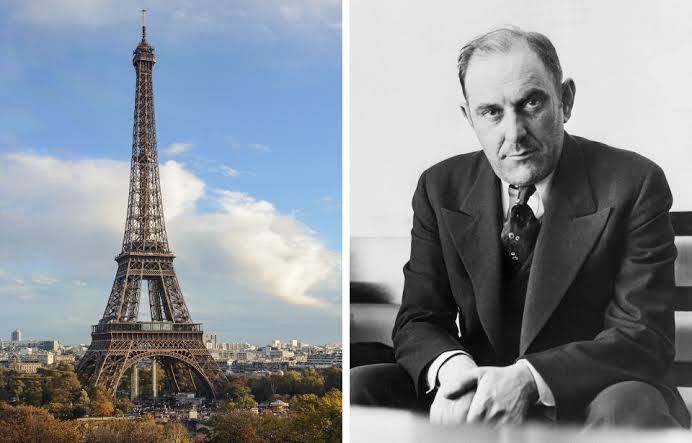
A man named Victor Lustig was a trickster. In 1925, he heard that Paris did not want the Eiffel Tower. It was old and rusty. Victor pretended to be a government official. He met with scrap metal sellers. He told them the city wanted to sell the tower. One man gave him money. Victor took the money and ran away. He left Paris. One month later, he returned. He sold the same tower again. The second buyer did not call the police. He was too embarrassed.
📖 Level 2 – Intermediate:
In 1925, the Eiffel Tower was almost 40 years old. Many Parisians thought it was ugly and expensive to maintain. Newspapers wrote stories about possibly tearing it down. A clever con artist named Victor Lustig saw an opportunity. He pretended to be the Deputy Director of the Ministry of Posts and Telegraphs. He invited several scrap metal dealers to a secret meeting at a fancy hotel. Lustig told them the government had decided to sell the Eiffel Tower for scrap, but the news was secret. He asked for bids. One dealer named André Poisson wanted to impress the government. He gave Lustig a large bribe and also paid for the "rights" to the tower. Lustig took the money — about $40,000 in today's value — and fled to Austria. Poisson was too ashamed to go to the police. Amazingly, Lustig returned to Paris one month later. He ran the same scam again on different dealers. The second victim did call the police, but Lustig escaped and was never caught for that crime. He was later arrested for counterfeiting and died in Alcatraz prison in 1947. He remains the only man in history to sell the Eiffel Tower — twice.
📖 Level 3 – Advanced:
Victor Lustig, born in what is now the Czech Republic in 1890, was perhaps the most audacious con artist of the 20th century. His curriculum vitae included selling worthless "money-printing machines," faking a letter from the British royal family, and duping Al Capone (who was so impressed by the attempt that he gave Lustig $5,000). But his masterpiece occurred in 1925. At the time, the Eiffel Tower was widely derided by Parisian artists and intellectuals. It had been built for the 1889 World's Fair and was intended to be dismantled after 20 years. By 1925, it was rusting and expensive. Rumors circulated in the press about whether the city should finally tear it down. Lustig saw his opening. He forged official government documents and invited six scrap metal dealers to a meeting at the Hôtel de Crillon, a luxury establishment. Introducing himself as the "Deputy Director of the Ministère de Postes et Télégraphes," he explained that the government had secretly decided to sell the tower for scrap to avoid public outcry. He drove the dealers to the tower in a chauffeured limousine, pointed out the logistical challenges, and opened bidding. André Poisson, a dealer anxious to prove himself, offered the highest bribe — $40,000 in a briefcase. Lustig accepted, then fled to Austria the same night. Poisson, realizing he had been swindled, was too humiliated to inform the police. Emboldened, Lustig returned to Paris one month later. He selected four different scrap dealers and ran the exact same scheme. This time, the dealer — upon discovering the fraud — did notify the authorities. Lustig escaped to the United States with the money, never to be prosecuted for the Eiffel Tower con. He was eventually imprisoned for counterfeiting US currency and died on Alcatraz Island in 1947. No one else has ever sold a national monument, let alone sold it twice. Victor Lustig did not just beat the system. He made the system look foolish — from the top of the Eiffel Tower all the way down.
Newsletter
Get new articles by email
Level-appropriate English news when we publish. Free, no spam.
New stories
Free
Unsubscribe anytime
Comments (0)
Comments are published after admin approval.
No approved comments yet. Be the first to comment.

Comments (0)
Comments are published after admin approval.
No approved comments yet. Be the first to comment.