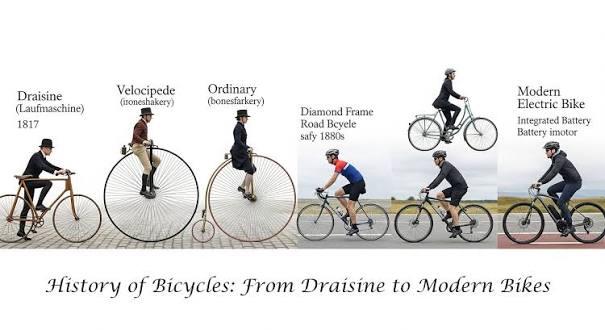
The bicycle evolved from a wooden walking machine in 1817 to the high-speed carbon-fiber bikes of today. Key milestones
include the pedal-powered velocipede, the penny-farthing with its giant front wheel, and the 1885 safety bicycle that established the modern chain-driven design. Innovations in materials, gears, and aerodynamics have made cycling faster, lighter, and more accessible than ever.
📖 Level 1 - Beginner:
The first bicycle had no pedals. It was made of wood. People pushed it with their feet. This was in 1817. Later, someone added pedals to the front wheel. This was the velocipede. It was called the "boneshaker" because it was very bumpy. Then came the penny-farthing. It had a giant front wheel and a tiny back wheel. It was fast but dangerous. In 1885, the safety bicycle came. It had two wheels the same size. It also had a chain. This design is still used today. Over time, bikes got lighter. They used metal and rubber tires. Now we have carbon-fiber bikes. They are very fast and light. Bicycles have changed a lot. They are now for fun, sport, and transport.
📖 Level 2 – Intermediate:
The bicycle's journey began in 1817 with Karl von Drais's "running machine"—a wooden frame with no pedals, propelled by the rider's feet. In the 1860s, pedals were added to the front wheel, creating the velocipede, nicknamed the "boneshaker" for its uncomfortable ride on cobblestones. The penny-farthing, introduced in the 1870s, featured a huge front wheel for speed and a tiny rear wheel for stability. It was fast but dangerous—falls were common. The breakthrough came in 1885 with the safety bicycle, which had two equal-sized wheels and a chain-driven rear wheel. This design was stable, comfortable, and practical. It sparked a cycling boom, especially for women, who gained new mobility. Since then, bicycles have evolved with pneumatic tires, multiple gears, lightweight aluminum and carbon-fiber frames, and aerodynamic designs. Today, bicycles are used for recreation, sport (like the Tour de France), and eco-friendly commuting. From a wooden hobby horse to a high-tech machine, the bicycle is one of humanity's most enduring and beloved inventions.
📖 Level 3 – Advanced:
The bicycle's evolution mirrors technological and social change. It began in 1817 with the German inventor Karl von Drais, who introduced the Laufmaschine ("running machine")—a two-wheeled, pedal-less wooden frame propelled by foot power. The 1860s saw the addition of pedals to the front wheel, creating the boneshaker, named for its jarring ride. The penny-farthing,
popular in the 1870s, featured a direct-drive front wheel up to 1.5 meters tall, enabling speed but at the cost of stability and safety. The modern bicycle emerged in 1885 with John Kemp Starley's Rover Safety Bicycle, which used a chain to drive the rear wheel and had two equal-sized wheels—a geometry so effective that it remains standard today. This design democratized cycling, especially for women, who found new independence. Subsequent innovations included pneumatic tires (1888), derailleur gears (early 1900s), lightweight aluminum and titanium frames (1970s), and today's advanced carbon-fiber composites and electronic shifting systems. Aerodynamic engineering has pushed competitive cycling to new extremes, while e-bikes and folding designs have expanded urban mobility. More than a transport device, the bicycle is a symbol of human
ingenuity—a simple, efficient, and enduring machine that continues to evolve with the times.

Comments (0)
Comments are published after admin approval.
No approved comments yet. Be the first to comment.