
The Secret of the Bermuda Triangle
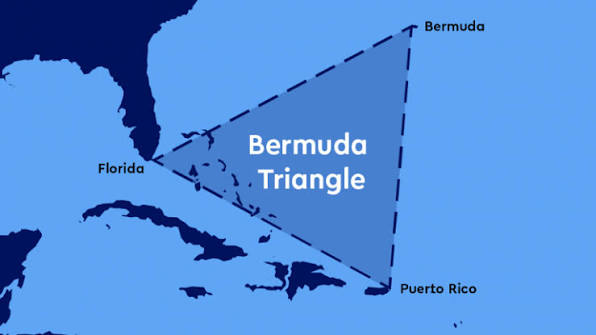
The Bermuda Triangle, a region between Miami, Bermuda, and Puerto Rico, is famous for mysterious disappearances of ships and planes. Stories blame aliens, time warps, or Atlantis. However, scientists and investigators found that most incidents have logical explanations: sudden storms, human error, magnetic variations, or massive methane bubbles. The US Coast Guard notes that the number of missing vessels is not higher than in any other heavily traveled ocean area. The real mystery? Why people still believe the myth.
📚 Vocabulary
Words from this article that appear in our vocabulary books.
| Word | Definition |
|---|---|
| About | a bit more or a bit less |
| Alleged | asserted: reported, supposed;an alleged crime, fact etc is one that someone says has happened or is true, although it has not been proved |
| Area | a particular part of a place, piece of land, or country |
| Author | the writer of a particular book or play or sth |
| Can | used with see, smell or taste in the continuous tense |
| Canal | a long, thin stretch of water that is artificially made either for boats to travel along or for taking water from one area to another |
| Cite | refer to, quote |
| City | a large town |
| Coast | the area of land that is close to or next to the sea or an ocean |
| Confirmation | a statement or proof that something is true |
| Converging | concentrating |
| Current | present |
| Distinct | separate: clear and recognizable |
| Due | expected to arrive or happen |
| During | at a point of within a period of time |
| Earth | our planet |
| Evidence | that which makes clear the truth or falsehood of something |
| Found | to establish: start up a philanthropic organization # establish |
| Gas | a substance like air, e.g. oxygen and hydrogen |
| Guard | a person or group of people who protect sth/sb |
| Hazard | danger, peril |
| However | yet, but |
| Human | connected with people |
| Include | to have something as a part (SYN contain) |
| Intermediate | in-between |
| Investigation | a careful examination in order to determine facts # probe |
| Keep | continue or stay ina particular place or condition |
| Large | extensive, big |
| Legend | story coming from the past, which many people have believed; what is written on a coin or below a picture |
| Like | used to introduce an example (SYN such as) |
| Logical | reasonable; reasonably expected |
| Massive | big and heavy; large and solid; bulky |
| Moreover | additionally: in addition, furthermore |
| Mundane | material: ordinary, lacking interest or excitement |
| Mysterious | not easily understood or figured out # baffling |
| Mystery | a story in which the events are only explained at the end |
| Myth | an invented story or idea # legend |
| Ocean | a very large area of sea |
| Part | some but not all of a thing |
| Plausible | 1)believable 2)apparently reasonable and valid |
| Popular | liked by most people |
| Properly | correctly or well |
| Proportion | a part or share of a the whole amount or number |
| Range | vary : to include a variety of different things or people in addition to those mentioned |
| Region | is part of a country or the world |
| Release | to allow to come out; to give freedom # free |
| Risk | danger |
| Rocks | the dry solid part of the earth's surface, or any large piece of this that sticks up out of the ground or the sea |
| Safe | a person you can rely on |
| Say | the right to take part in deciding sth (give sb a say/have a say in sth) |
| Selective | carefully chosen # discriminating |
| Sensational | extraordinary |
| Ship | a large boat for travelling on water, especially across the sea |
| Significant | meaningful: important |
| Sink | descend: drop to the bottom: pass out of sight |
| Square | a flat shape with four sides of equal length and four angles of 90° |
| Stream | water that flows naturally along a fixed route formed by a channel cut into rock or ground, usually at ground level |
| Sudden | happening very quickly |
| Training | the activity of teaching people the skills they need for a job |
| Violent | acting or done with strong, rough force |
| Wave | a raised line of water that moves across the surface |
| Within | inside |
| Yet | however |
| Zone | an area or region with a particular feature. a war/danger zone |
Comments (0)
Comments are published after admin approval.
No approved comments yet. Be the first to comment.