
The History of The Fork
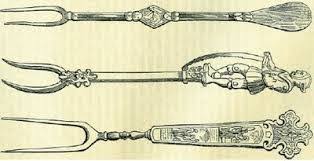
In ancient civilisations, the fork was virtually unknown as a dining implement. Among the elites of Ancient Egypt and later the Roman Empire, food was typically eaten with the fingers or using spoons and knives. However, early metal prototypes resembling two-pronged forks have been found in archaeological sites near Rome, dating to approximately 400 CE. These objects were not used for eating but rather for serving meat or retrieving food from boiling cauldrons. For those few who owned them, they signified wealth and technological sophistication, as most households relied solely on their hands. The design has changed little in its basic principle, yet its social meaning has transformed entirely.
A specific innovation occurred in 11th-century Middle East, where court cooks in Persia began using a narrow, three-pronged tool made of silver to test and handle hot sweets. By the year 1070, this implement had evolved into a refined dining fork with two straight tines, crafted from iron and sometimes plated with gold. The material used, silver, was chosen for its resistance to corrosion and its association with purity. Persian nobles adopted the fork for eating delicate fruits and rice dishes, preventing stains on their elaborate robes.
The fork arrived in Europe during the late 18th century, popularised by the Venetian noblewoman Cristina di Milano. When she used a small silver fork at banquets in Paris in 1795, French diners mocked her openly, calling the tool an insult to nature. Resistance was so strong that church officials initially condemned the fork as an affront to God's gift of fingers. Despite the ridicule, Cristina persisted, and by 1820 the fork had become standard among European upper classes. The design has changed little, but the fork eventually replaced fingers across the Western world.
📚 Vocabulary
Words from this article that appear in our vocabulary books.
| Word | Definition |
|---|---|
| Ancient | antique: old- belonging to a long time in old history |
| Approximately | roughly-more or less than a number or amount |
| Century | 100 years |
| Court | a place where trials and other legal cases happen |
| Delicate | dainty, graceful |
| Design | create, draw, plan |
| Despite | in spite of |
| During | at a point of within a period of time |
| Elaborate | detailed- intricate-complex 1.1 having a lot of small parts or details put together in a complicated way SYN intricate 2. carefully planned and organized in great detail SYN complex |
| Entirely | wholly,completely and in every possible way |
| Eventually | finally: later: ultimately: in the end |
| Found | to establish: start up a philanthropic organization # establish |
| Gift | a thing that you give to sb, e.g. for their birthday SYN present |
| Handle | a part of an object designed for holding, moving, or carrying the object easily |
| However | yet, but |
| Implement | 1)put into action: 2.tool,a tool, especially one used for outdoor physical work. |
| Initially | originally, at first [adv] |
| Innovation | new, novelty |
| Material | cloth for making clothes, covering furniture, etc (SYN fabric) |
| Middle | centre |
| Narrow | limit, restrict, confine, curb [v] |
| Nature | character, disposition, temperament |
| Principle | rule: standard |
| Refined | decent-with high quality -improved |
| Resembling | approximating |
| Resistance | the action of trying to stop sth happening or stop sb doing sth |
| Solely | only, not involving sb/sth else |
| Sophistication | technology n. |
| Specific | particular |
| Standard | normal; average |
| Straight | continuing in one direction without bending or curving |
| Test | a medical examination of part of your body |
| Three | 3 |
| Two | 2 |
| Virtually | nearly: almost: nearly: actually: in fact |
| Yet | however |
Comments (0)
Comments are published after admin approval.
No approved comments yet. Be the first to comment.