
The History of The Button
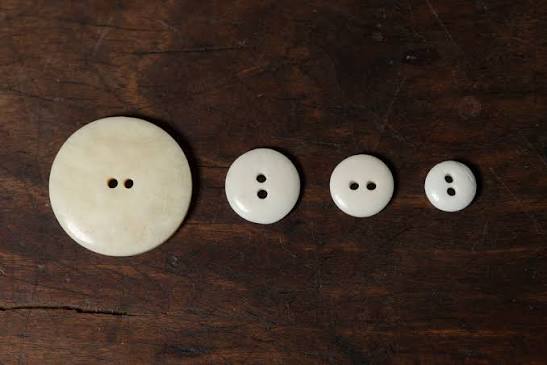
In ancient civilisations, buttons served a purely ornamental purpose rather than a functional one. Among the elite of Ancient Rome and Egypt, around 2000 BCE, buttons crafted from bone, ivory, or precious metals were used as decorative seals or brooches to denote wealth and social standing. Possessing a button signified one’s elevated status, as the common populace relied on simple pins or laces to fasten garments. Thus, the button functioned primarily as a luxury item, its presence on a tunic or cloak marking the wearer as a person of means.
A significant innovation emerged in 13th-century China, where artisans developed the first functional button-and-loop closure. Instead of precious materials, they turned to carved wood and polished horn, creating durable fastenings that could be mass-produced. This advancement spread westward along trade routes, reaching the Middle East by 1350. Crucially, the Chinese also introduced the buttonhole, a simple slit that allowed the button to pass through fabric securely. The design has changed little since this fundamental breakthrough, which transformed the button from decoration into an indispensable clothing component.
The button did not arrive in Europe with universal acclaim until the late 18th century. The French tailor and courtier Jacques Lefèvre championed its use in men’s waistcoats and breeches, arguing that buttons offered both elegance and efficiency. However, he faced open mockery; critics claimed that buttons were effeminate or excessively complicated, and some European nobles derisively referred to them as “useless baubles.” Resistance persisted for nearly three decades, yet by 1850, buttons had become ubiquitous across all social classes. The design has changed little since that era, and today buttons remain a quiet testament to ancient ingenuity.
📚 Vocabulary
Words from this article that appear in our vocabulary books.
| Word | Definition |
|---|---|
| Acclaim | enthusiastic approval; applause # praise |
| Ancient | antique: old- belonging to a long time in old history |
| Bone | any of the hard parts inside a human or animal that make up its frame |
| Breakthrough | revolution, success, advance, development, innovation, progress;an important new discovery in something you are studying |
| Century | 100 years |
| Closure | a situation in which a school, factory, etc. is permanently shut |
| Complicated | complex -made things more difficult |
| Component | constituent,constitution |
| Crucially | decisively, definitely |
| Design | create, draw, plan |
| Durable | lasting, enduring |
| Elite | excellent person |
| Era | period |
| Fabric | cloth or material for making clothes, covering furniture, etc. (SYN material) |
| Fundamental | basic, essential, vital, crucial |
| Horn | a device on a vehicle that is used to make a loud noise as a warning or signal to other people |
| However | yet, but |
| Indispensable | essential: necessary: needed: required: significant: vital |
| Ingenuity | cleverness: creativeness: inventiveness: resourcefulness |
| Innovation | new, novelty |
| Item | a thing or an object |
| Means | ways # methods |
| Middle | centre |
| Nearly | almost, closely, approximately |
| One | 1 |
| Ornamental | decorative |
| Pass | went by, elapsed |
| Precious | valuable |
| Primarily | mainly |
| Resistance | the action of trying to stop sth happening or stop sb doing sth |
| Significant | meaningful: important |
| Spread | distribute |
| Three | 3 |
| Through | by |
| Thus | consequently: therefore |
| Ubiquitous | common |
| Yet | however |
Comments (0)
Comments are published after admin approval.
No approved comments yet. Be the first to comment.