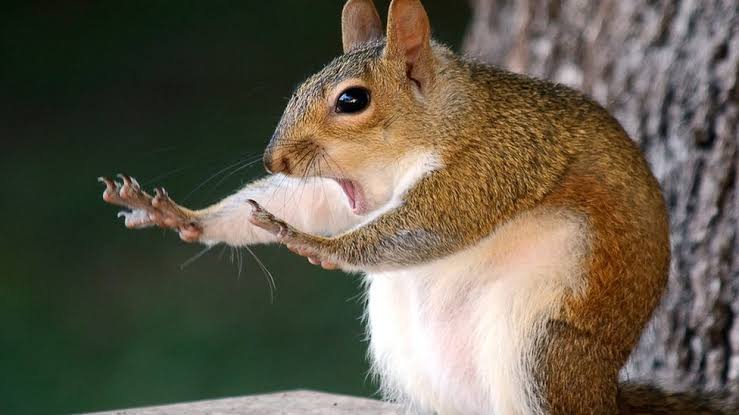
Squirrels zigzag, jump, fake bury nuts, and stare at humans like tiny comedians. Their seemingly crazy behavior is actually clever survival intelligence. They have excellent memory, problem-solving skills, and even deceive other animals. Next time a squirrel steals your snack, remember: it is not being rude — it is just being a very smart squirrel.
📖 Level 1 - Beginner:
Squirrels are funny little animals. They run fast and jump high. They act like they are crazy. But squirrels are actually very smart. They hide nuts in many places. Sometimes they pretend to hide a nut. They scratch the ground but keep the nut. This tricks other animals. Squirrels also stare at people. They want to know if you are dangerous. Their big eyes look very cute. Squirrels remember where they hide food. They can find thousands of nuts. They also solve puzzles to get treats. Scientists think squirrels are very clever. The next time a squirrel steals your snack, do not get angry. The squirrel is just being a squirrel. It is not trying to be mean. It is trying to survive. Watch them jump from tree to tree. They look like tiny comedians. Their funny moves make us laugh. But behind the comedy is a smart brain. Squirrels are nature’s little clowns.
📖 Level 2 – Intermediate:
If you have ever watched a squirrel, you have seen them zigzag, freeze, stare, and leap like acrobats. Their behaviour looks like a comedy show. But this "craziness" is actually survival intelligence. Squirrels practice deceptive caching — they dig a hole, pretend to drop a nut, then cover it up while keeping the nut in their mouth. This tricks other animals who might steal their food. They also have excellent spatial memory. A squirrel can remember the locations of thousands of buried nuts for months. They even use landmarks and mental maps. Their dramatic jumps and sprints help them escape predators like hawks and cats. The sudden stop-and-stare? That is them checking for danger. Scientists have tested squirrels with puzzle boxes. Squirrels learn quickly and remember solutions for years. So next time a squirrel stares at you from a tree branch, it is not being rude. It is calculating if you are a threat — or a source of snacks. From fake burials to fearless rooftop races, squirrels are nature’s tiny comedians with a surprisingly serious brain behind the jokes.
📖 Level 3 – Advanced:
The humble squirrel, often dismissed as a chaotic acrobat, exhibits a repertoire of behaviours that blur the line between slapstick comedy and strategic genius. Consider deceptive caching: when a squirrel senses an audience (another squirrel or a bird), it may perform an elaborate "fake bury" — digging a hole, miming dropping a seed, and covering the empty spot while the real nut remains hidden in its cheek pouch. This is tactical deception, previously thought limited to primates. Their erratic zigzag sprints are not random; they follow an anti-predator algorithm that makes them unpredictable to hawks. The famous freeze-and-stare? That is vigilant assessment of threat level. Neuroethologists have found that squirrels possess remarkable spatial memory, using relative landmarks and even sun position to retrieve up to 9,000 buried nuts. In laboratory experiments, grey squirrels solved multi-step puzzles in under two minutes and retained the solution for 22 months. So when a squirrel raids your bird feeder, performs a backflip onto your fence, then pauses to stare into your window — it is not being a goofball. It is running a cost-benefit analysis. The comedy is our projection. The intelligence is all theirs. Next time you laugh at a squirrel, know that the joke might actually be on you.
Newsletter
Get new articles by email
Level-appropriate English news when we publish. Free, no spam.
New stories
Free
Unsubscribe anytime
Comments (0)
Comments are published after admin approval.
No approved comments yet. Be the first to comment.

Comments (0)
Comments are published after admin approval.
No approved comments yet. Be the first to comment.