
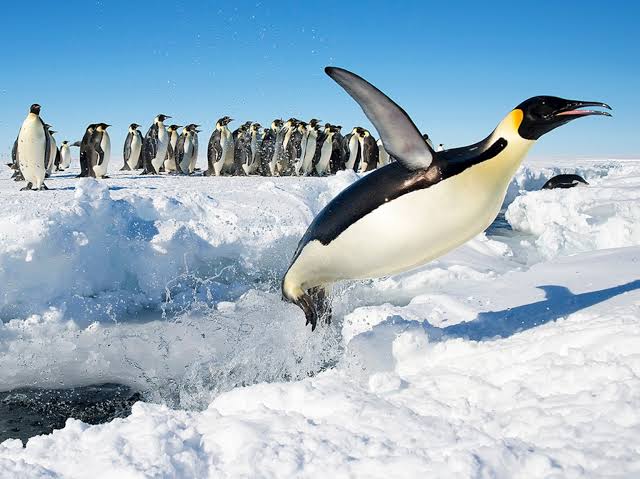
Penguins are birds that cannot fly in the air because their wings evolved into flippers for swimming. This adaptation allows them to dive deep into the ocean to catch fish. Their heavy bones and waterproof feathers help them move efficiently underwater while keeping them warm in cold climates.
Level 1 - Beginner:
Why Penguins Don't Fly but Dive Penguins are very special birds. Most birds use their wings to fly in the sky, but penguins do not. Instead, penguins use their wings to swim. Their wings are small and strong. They look like flippers. These flippers help them move fast in the water. Why did this happen? Penguins need to find food. Their food, like fish and squid, lives in the ocean. To get this food, penguins must dive deep. Their bodies are built for the water. They have heavy bones. These bones help them sink and dive easily. They also have thick feathers. These feathers keep them warm in the cold ice and water. Penguins cannot fly in the air, but they are amazing swimmers. They "fly" through the ocean to catch their dinner. They are perfect for their cold homes.
Level 2 - Intermediate:
Why Penguins Don't Fly but Dive Penguins are unique birds because they have traded the ability to fly for the ability to swim. While most birds have lightweight wings for the air, penguins have evolved short, stiff flippers. These flippers act like paddles, allowing them to glide through the ocean with great speed and agility. This evolutionary change happened because penguins rely on the sea for survival. Since their primary food sources, such as fish and krill, are underwater, diving is more important than flying. To assist with this, penguins have denser, heavier bones than other birds, which helps them dive deeper into the cold water. Additionally, their bodies are covered in densely packed, waterproof feathers. This layering provides essential insulation against freezing temperatures. Although they may seem clumsy on land, penguins are incredibly efficient hunters in the water. By adapting their anatomy, they have become masters of the deep sea rather than the open sky.
Level 3 - Advanced:
Why Penguins Don't Fly but Dive While the defining characteristic of most avian species is flight, penguins represent a fascinating evolutionary deviation. Instead of soaring through the atmosphere, penguins have adapted to thrive in marine environments. Their wings have evolved into rigid, paddle-like flippers, which are far more effective for propulsion through dense water than for generating lift in the air. This transition occurred because the penguin's ecological niche shifted toward the ocean. To successfully hunt prey like fish and squid, these birds required the ability to dive to significant depths. Consequently, they developed heavy, solid bones—a stark contrast to the hollow bones found in flying birds—which act as ballast to overcome buoyancy. Furthermore, their physiological adaptations include a specialized layer of waterproof feathers and a thick layer of blubber, ensuring they remain thermally insulated in frigid Antarctic waters. This streamlined body shape reduces drag, allowing them to "fly" through the water with remarkable precision. Ultimately, the loss of aerial flight was a necessary trade-off, enabling penguins to become highly specialized aquatic hunters. Their anatomy is a perfect example of how evolution optimizes a species for its specific environment.
Comments (0)
Comments are published after admin approval.
No approved comments yet. Be the first to comment.