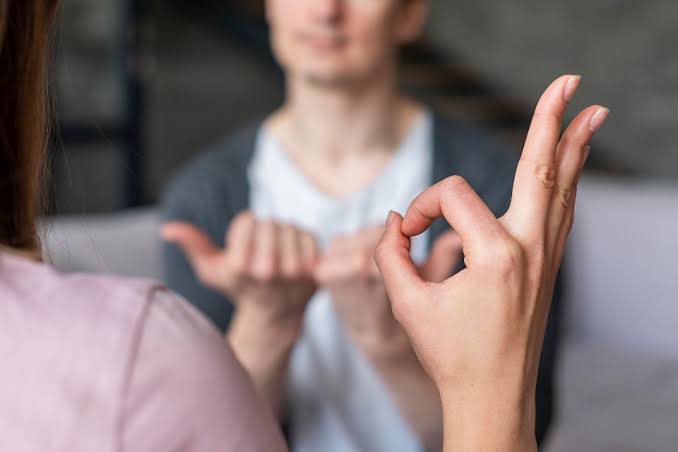
Sign language is a complete, natural language that uses hand shapes, movements, facial expressions, and body positioning. It is not universal — different countries have different sign languages, such as American Sign Language (ASL) and British Sign Language (BSL). Sign languages develop naturally within deaf communities and have their own grammar, separate from spoken languages.
📖 Level 1 - Beginner:
Sign language is how deaf people talk. They use their hands and faces. Each hand shape has a meaning. Moving your hand changes the meaning. Your face is also important. Raising your eyebrows can ask a question. Smiling shows happiness. Sign language is not the same everywhere. American Sign Language is different from British Sign Language. In the US, you use one hand for the alphabet. In the UK, you use two hands. That is very different. Sign language has grammar. You do not sign every word like English. You put signs in a special order. For example, you sign "store I go" instead of "I go to the store." Deaf children learn sign language naturally. They learn it like hearing children learn spoken language. Parents can learn sign language too. They can talk to their deaf babies. Babies can sign before they can speak. Sign language is a real language. It is not just gestures. It is beautiful and powerful. Millions of people use it every day.
📖 Level 2 – Intermediate:
Sign language is a full, natural language used by deaf communities worldwide. Many people mistakenly think sign language is just gestures or a universal code. In fact, there are over 300 different sign languages. American Sign Language (ASL) and British Sign Language (BSL) are completely different — a signer from the US cannot understand a signer from the UK. ASL uses a one‑handed alphabet, while BSL uses two hands. Sign languages have their own grammar, separate from spoken languages. ASL does not follow English word order. Instead, it uses topic‑comment structure. For example, to say "I went to the store yesterday," an ASL signer might sign "YESTERDAY STORE I GO." Time signs usually come first. Facial expressions act like punctuation or tone. Raising your eyebrows can turn a statement into a yes/no question. Frowning or puffing your cheeks adds meaning. Sign languages also use space. A signer can point to a location in the air to refer to a person who is not present, then return to that spot later. This is called “spatial grammar.” Deaf children raised with sign language hit language milestones at the same age as hearing children. Sign languages are not simplified or broken — they are rich, expressive, and capable of poetry, jokes, and complex ideas.
📖 Level 3 – Advanced:
Sign language is a visual‑gestural language that exhibits the same linguistic complexity as any spoken language, complete with phonology, morphology, syntax, and semantics. Critically, sign languages are not derived from spoken languages; they evolve independently within deaf communities. American Sign Language (ASL), for example, shares no grammatical structure with English. Its roots trace to Old French Sign Language, brought to the US in the early 19th century. One of the most fascinating features is the use of “non‑manual markers” — facial expressions, head movements, and body posture that carry grammatical weight. In ASL, raising the eyebrows and leaning forward marks a conditional clause (“if it rains”). Lowering the eyebrows and tilting the head indicates a wh‑question (“who did it?”). Another core feature is classifier constructions. The signer uses hand shapes to represent objects (e.g., a flat hand for a car, two fingers for a person) and moves them through space to show action, location, or interaction (“the car passed the person and turned left”). This creates a three‑dimensional, cinematic narrative. Sign languages also exhibit “simultaneous morphology” — unlike spoken languages, which string sounds linearly, a signer can produce multiple morphemes at once (hand shape, location, movement, and facial expression all contributing meaning). Research in neurolinguistics shows that sign language is processed in the same left‑hemisphere brain regions as spoken language, despite the visual‑spatial modality. Importantly, sign languages are not universal. ASL, British Sign Language (BSL), Japanese Sign Language, and others are mutually unintelligible. Even among countries sharing the same spoken language — the US and UK — their sign languages are completely different. Sign language poetry, storytelling, and wordplay (like rhymes based on hand shape rather than sound) demonstrate its artistic depth. Recognizing sign language as a full language has profound implications for deaf education, accessibility, and human rights.
Newsletter
Get new articles by email
Level-appropriate English news when we publish. Free, no spam.
New stories
Free
Unsubscribe anytime
📚 Vocabulary
Words from this article that appear in our vocabulary books.
Word
Definition
Age
a particular time in history. e.g. ice age
Air
feeling
Alphabet
a set of letters arranged in a fixed order using a writing a language
Based
when sth is the centre for your work
Brain
the organ inside the head that controls thought, memory, feelings, and activity
Can
used with see, smell or taste in the continuous tense
Century
100 years
Completely
totally
Complex
1) system (n),a group of buildings, or a large building with many parts, used for a particular purpose,2) elaborate (adj)
Core
center, hub, nucleus
Deaf
not able to hear
Demonstrate
take part in a public protest for or against sth
Depth
distance down
Despite
in spite of
Develop
grow or increase
Even
at the same level
Evolve
develop
Exhibit
display; show
Expression
a word or group of words used in a particular situation or a particular people
Eyebrows
the lines of short hairs above eyes in humans
Face
to be in the presence of and oppose # confront
Fascinating
extremely attractive
Feature
an important part of sth, and often a part that you notice
Follow
track, pursue, chase
Human
connected with people
Intermediate
in-between
Like
used to introduce an example (SYN such as)
Manual
a book that tells you how to do or use sth such as a car or a computer
Might
used to express the possibility that something will happen or be done, or that something is true although not very likely
Poetry
poems in general
Present
a thing that you give to sb, e.g. for their birthday SYN gift
Produce
being responsible for business side of a film
Profound
far-reaching: deep
Refer
hand over; send; direct, or turn for information, help, or action; (refer to) direct attention or speak bout; assign to or think of as caused by
Represent
to speak, act, or be present officially for another person or people
Say
the right to take part in deciding sth (give sb a say/have a say in sth)
Separate
different
Shape
the particular physical form or appearance of something
Shares
units of equal value that a company is divided into and which are then sold to raise money
Space
the area beyond the earth round the planets and stars
Spot
catch: identify: see
String
series
Through
by
Topic
subject that people think, write, or talk about
Turn
change to
Weight
how heavy sth is (value/property)
While
although
Within
inside
Worldwide
existing or happening in all parts of the world
Comments (0)
Comments are published after admin approval.
No approved comments yet. Be the first to comment.

Comments (0)
Comments are published after admin approval.
No approved comments yet. Be the first to comment.