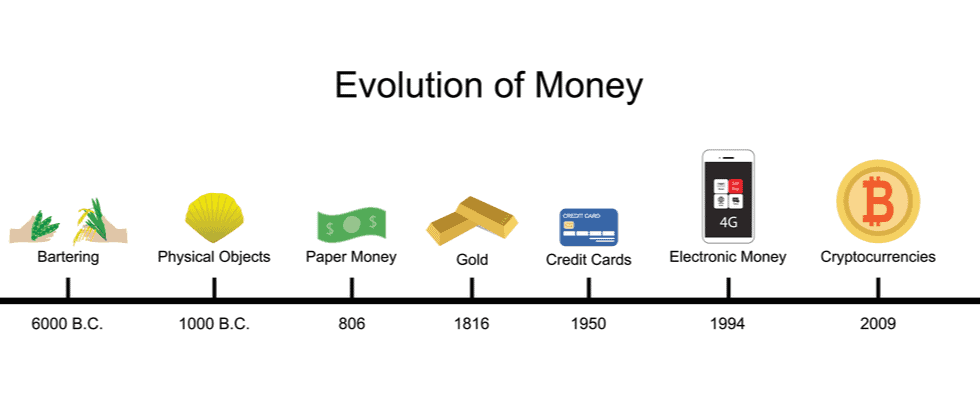
Money has not always been coins or paper. People once used cowrie shells, salt, cattle, and even giant stone wheels. Metal coins appeared around 600 BCE. Paper money came from China. Today, most money is digital — just numbers on a screen. The history of money is the history of trust.
📖 Level 1 - Beginner:
Long ago, there was no money. People traded things. They gave a chicken for some rice. This was hard. So people invented money. The first money was strange. Some used cowrie shells. Some used salt. Some used big stone wheels. Then people made metal coins. The first coins were made around 2,600 years ago. They were silver and gold. Later, China invented paper money. Paper was lighter than coins. But paper money needed trust. People had to believe it was worth something. Today, we have digital money. You tap your phone or card. No shells. No coins. No paper. Just numbers. Most money in the world is digital now. It moves in clicks and beeps. Money changes a lot. But its job is the same. It helps us trade. It works because we all agree to trust it. That is the real secret of money.
📖 Level 2 – Intermediate:
Before money, humans used barter — trading goods directly. But barter failed if you had chickens but wanted shoes. So people created commodity money: objects with value. The Yap Islands used giant stone wheels called rai. West Africa used cowrie shells. Early Europeans used cattle or salt (the word “salary” comes from salt). Around 600 BCE, the Lydians (in modern Turkey) made the first metal coins from electrum, a natural gold‑silver mix. Coins were durable, portable, and countable. China later invented paper money during the Tang Dynasty (600s CE) but made it official under the Song (1000s CE). Paper was lighter but required government backing. For centuries, paper money was tied to gold or silver. That changed in 1971 when the US abandoned the gold standard. Now, money is fiat money — valuable only because governments say so. Today, over 90% of money exists digitally as bank records, credit card balances, or cryptocurrency. From shells to smartphone taps, money keeps evolving. Its foundation is always the same: shared belief.
📖 Level 3 – Advanced:
The history of money is a history of trust. In pre‑monetary societies, barter dominated — but it suffered from the “double coincidence of wants.” To solve this, various cultures adopted commodity money. The Yapese used rai stones (some over three meters tall), while Native Americans used wampum beads. As trade expanded, metal coins emerged around 600 BCE in Lydia under King Alyattes. Made of electrum, they featured official stamps guaranteeing weight and purity — an early form of state‑backed currency. Paper money appeared in 11th‑century China during the Song Dynasty, initially as promissory notes for merchants. The Mongol Yuan Dynasty later issued nationwide paper currency, but overprinting led to hyperinflation. European explorers encountered paper money and eventually adopted it. The gold standard (19th‑20th centuries) tied paper to precious metals, but it collapsed during the Great Depression and officially ended in 1971 under President Nixon’s “Nixon Shock.” Today, most money is fiat currency — value derived solely from legal tender laws and public confidence. Moreover, 90%+ of money exists only digitally: bank ledger entries, credit card transactions, and cryptocurrencies like Bitcoin. Whether cowrie shell or blockchain, money is a shared fiction that organizes human cooperation. Its next chapter is already being written in code.
Newsletter
Get new articles by email
Level-appropriate English news when we publish. Free, no spam.
New stories
Free
Unsubscribe anytime
📚 Vocabulary
Words from this article that appear in our vocabulary books.
Word
Definition
Backing
help. support, abck sb/sth
Bank
slopping raised land, especially along the sides of the river
Being
creature, existence
Cattle
cows and bulls that are kept for their milk or meat
Century
100 years
Chapter
one of the parts into which a book is divided
Coincidence
likely events, fortune, accident, chance
Credit
iif you are in credit, there is money in your account
Currency
monetary unit # money
Depression
a feeling of being very unhappy
Durable
lasting, enduring
During
at a point of within a period of time
Even
at the same level
Eventually
finally: later: ultimately: in the end
Fiction
that which is imagined or made up
Giant
huge,extremely big, and much bigger than other things of the same type
Goods
things that are made to be sold
Government
the group of people in control of a country
Human
connected with people
Initially
originally, at first [adv]
Intermediate
in-between
King
a male ruler of a country, who holds this position because of his royal birth
Legal
allowed by law
Like
used to introduce an example (SYN such as)
Moreover
additionally: in addition, furthermore
Native
connected with the place where you were born and lived for the first years of your life
Paper
the written questions in an exam
Portable
can be carried or moved easily
Precious
valuable
President
the leader of a country with no king or queen
Public
people
Say
the right to take part in deciding sth (give sb a say/have a say in sth)
Screen
filter v
Shell
a metal case full of explosives, to be fired from a large gun. shell sth= fire shell at sth
Solely
only, not involving sb/sth else
Standard
normal; average
Stone
the hard, solid substance found in the ground that is often used for building, or a piece of this
Trust
to believe that someone is good and honest and will not harm you, or that something is safe and reliable
Turkey
a large bird grown for its meat on farms
Value
think that sb/sth is important
Weight
how heavy sth is (value/property)
While
although
Worth
value of something in money equivalent
Comments (0)
Comments are published after admin approval.
No approved comments yet. Be the first to comment.

Comments (0)
Comments are published after admin approval.
No approved comments yet. Be the first to comment.