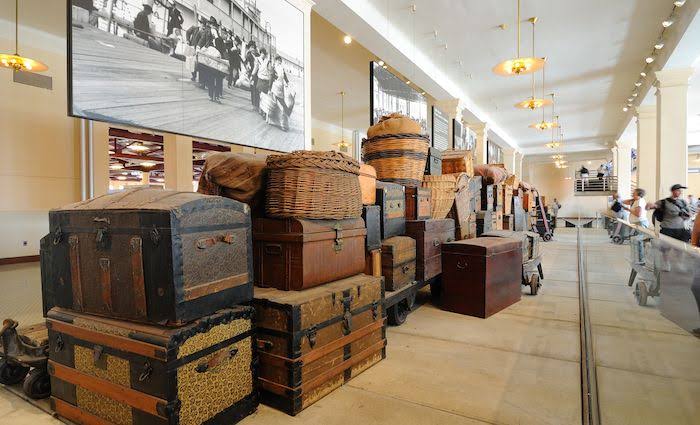
At Ellis Island in New York, there is a museum filled with suitcases. Each one belonged to an immigrant arriving in America between 1892 and 1954. One small brown suitcase contains only a wool coat, a loaf of bread, a family photograph, and a letter written in Italian. The owner was a 14-year-old girl traveling alone. Her story is lost. But her suitcase remains. It asks every visitor: What would you pack if you could never go home?
📖 Level 1 - Beginner:
Ellis Island is a museum in New York. It has many old suitcases. Each suitcase belonged to an immigrant. One small brown suitcase is special. Inside there is a coat, some bread, a photo, and a letter. The owner was a 14-year-old girl. She came to America alone. We do not know her name. We do not know her life. But her suitcase tells us she was brave. She left everything behind. She carried only what she needed. Her story is a mystery. But her suitcase speaks for her.
📖 Level 2 – Intermediate:
Ellis Island, located in New York Harbor, processed over 12 million immigrants between 1892 and 1954. Today, part of the island houses the Ellis Island National Museum of Immigration. Among its exhibits is a collection of actual suitcases left behind or donated by immigrants and their families. One display case holds a small brown suitcase, no bigger than a modern school backpack. Inside are five items: a heavy wool coat, a wrapped loaf of bread, a black-and-white family photograph showing seven people in front of a stone house, and a handwritten letter in Italian. The letter's date is smudged, but the museum estimates 1921. According to shipping records, the suitcase belonged to a 14-year-old girl who traveled alone in steerage class. Her name is not on the tag. No one knows if she met her relatives, found work, married, or returned to Italy. But her suitcase survived. It asks a powerful question: What would you pack if you were leaving your home forever — knowing you could never come back? The girl chose warmth (the coat), sustenance (the bread), memory (the photograph), and connection (the letter). She had no room for toys, books, or extra shoes. Immigrant stories are often about what people gain. This suitcase reminds us of what they lose — and what they choose to carry forward.
📖 Level 3 – Advanced:
Ellis Island's museum contains over 2,000 artifacts from the peak era of US immigration (1892–1954), but none speak as quietly or as loudly as Accession Number 1987.012.004 — a small, scuffed brown suitcase made of pressed cardboard and imitation leather. It measures 42 cm by 30 cm by 15 cm, roughly the size of a child's overnight bag. Inside, museum conservators found five objects: a hand-knit wool coat (child-sized, mended at the left elbow), a loaf of sourdough bread wrapped in wax paper (now petrified), a sepia photograph of a family of seven standing before a limestone farmhouse, and a two-page letter written in Italian on onionskin paper. The letter's author is a woman named Francesca, addressed to "My dearest daughter, Chiara." It reads in part: "You are only fourteen, but you are braver than I have ever been. Do not look back. America will be hard, but staying here is harder. The bread is from your grandmother's oven. Eat it on the ship when you feel alone." Passenger manifests confirm that Chiara Rossi, age 14, traveled alone in steerage on the SS Italia, arriving at Ellis Island on April 12, 1921. No further records exist. She may have been claimed by an uncle in Brooklyn. She may have died in the 1918 influenza pandemic's later wave. She may have changed her name, married, and lived to be 90. Ellis Island has no answer. The suitcase remains an object without a conclusion. Yet it functions as an artifact of universal displacement: what do we carry when home becomes memory? Chiara Rossi chose warmth, nourishment, memory, and a mother's words. She left behind everything else — her father, her siblings, her language, her landscape, her future self. Every immigrant story is a suitcase. Visible on the outside, a name and a destination. Hidden inside, a life packed in desperation and hope. Chiara's suitcase outlasted her. It now asks 2 million annual visitors the same question: What would you pack — and what would you leave behind?
Newsletter
Get new articles by email
Level-appropriate English news when we publish. Free, no spam.
New stories
Free
Unsubscribe anytime
📚 Vocabulary
Words from this article that appear in our vocabulary books.
Word
Definition
About
a bit more or a bit less
Age
a particular time in history. e.g. ice age
Annual
once a year; something that appears yearly or lasts for a year
Author
the writer of a particular book or play or sth
Choose
opt, select, adopt, set, specify, opposite of reject & decline
Confirm
prove to be true or correct; make certain
Display
to show; reveal # exhibit
Elbow
the part in the middle of the arm where it bends
Era
period
Exist
to be real
Feel
give a sensation of or like sth when touched
Found
to establish: start up a philanthropic organization # establish
Fourteen
14
Gain
obtain something
Harbor
to give protection; to not express a desire or opinion, usually bad # shelter
Immigrant
a person who comes to a foreghn country to live there
Immigration
movement, emigration
Intermediate
in-between
Landscape
scenery, a large area of countryside,a view or picture of the countryside, or the art of making such pictures
Letter
any of the set of symbols used to write a language
Look
turn your eyes to sth and pay attention to it; seem from what you can see
May
used to express possibility
Mystery
a story in which the events are only explained at the end
National
connected with all of a country
Object
something tangible
Overnight
for one night
Paper
the written questions in an exam
Part
some but not all of a thing
Peak
1)top 2)highest point 3)maximum 4)time of the greatest activity 5)summit/climax
Photo
a picture produced using a camera (SYN photograph)
Photograph
a picture produced using a camera (SYN photo)
Remains
parts of objects and buildings that have been discovered recently
Roughly
almost: approximately
Ship
a large boat for travelling on water, especially across the sea
Stone
the hard, solid substance found in the ground that is often used for building, or a piece of this
Sustenance
n) food: life: living
Visible
able to be seen
Warmth
a pleasant heat
Wave
a raised line of water that moves across the surface
Whole
entire
Work
get or have the result you want
Yet
however
Comments (0)
Comments are published after admin approval.
No approved comments yet. Be the first to comment.

Comments (0)
Comments are published after admin approval.
No approved comments yet. Be the first to comment.