
The Fastest Man on No Legs
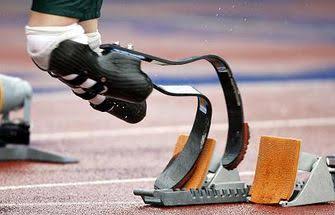
His name is Samuel, but they call him “the rocket without legs.”
At seventeen, Samuel lost both limbs below the knee to a landmine that wasn’t supposed to be in his village anymore. The war had ended six months earlier, but no one told the earth. He spent two years in a crowded hospital, learning to balance on stumps that ached in the rain. His mother sold her wedding bangles to buy his first pair of used prosthetic blades — stiff, cracked, and two sizes too small.
“You will never run,” the doctor said. Not cruelly. Just honestly.
Samuel kept the doctor’s name in a notebook. Not for revenge. For fuel.
At nineteen, he taught himself to jog. At twenty-one, he could sprint fifty meters on grass without falling. At twenty-three, a local coach spotted him chasing a chicken across a field — the chicken won, but barely — and laughed so hard he cried.
“You’re crazy,” the coach said.
“No,” Samuel replied. “I’m broke. Being broke and being crazy look the same from the outside.”
The coach, a failed runner himself, agreed to train Samuel for free. They had no track. No starting blocks. No timing gates. They had a dirt road, a hand-me-down stopwatch, and a deal: if Samuel ever won prize money, the coach got ten percent for new sandals.
The first race was a provincial Paralympic trial. Samuel arrived at the stadium and stared at the blue rubber track like a farmer seeing the ocean. The other athletes had carbon-fiber blades worth ten thousand dollars. They had team physios. They had matching warm-up suits with their names embroidered on the back.
Samuel had a number pinned to a torn t-shirt. His blades squeaked. One of them had been repaired with bicycle tire tube and hope.
He finished fourth. Not last — but last among those who mattered. The top three got sponsorship offers. Samuel got a banana from the volunteer snack table and a two-hour walk back to the bus stop.
That night, he sat on his bed and asked himself the question every poor athlete faces: How much longer can I afford to chase something that doesn’t want me?
He didn’t have an answer. But he had a mother who had sold her bangles. He had a coach who wanted new sandals. And he had two stiff, squeaky, ridiculous blades that had carried him farther than any doctor said possible.
So he ran.
Not for glory. Not for country. For the simple, stubborn math of it: every morning he ran, the world got a little smaller, and his possibilities got a little larger.
Two years later — after hundreds of lonely dawns, after a stranger saw a video of him training and bought him real blades, after placing fifth, then third, then second — Samuel stood on the starting line of the World Para Athletics Championships. Beside him were the same athletes who had beaten him before. The same expensive blades. The same embroidered names.
The gun cracked.
He doesn’t remember the race. He remembers the finish — looking up at the clock, seeing his name in first place, and feeling nothing for a full three seconds. Then his coach tackled him onto the track, crying so hard no words came out.
Afterwards, a reporter asked him, “What’s your secret?”
Samuel looked down at his blades — the new ones, the carbon-fiber ones that someone gave him when he was still nobody. He thought about the old pair, held together by bicycle tube. He thought about the doctor who said he would never run.
He smiled.
“I had less to lose than anyone else on that line,” he said. “When you start with nothing, every finish line feels like stealing.”
He never forgot the doctor’s name. After the championship, he sent the doctor a photograph — Samuel on the podium, gold medal around his neck, the biggest smile his face could hold.
On the back of the photograph, he wrote:
“This is what runs on no legs and a small budget.”
The doctor kept it in his clinic. For the next patient who needed to hear the truth: sometimes the fastest man isn’t the one with the best shoes. He’s the one who refused to believe the race was over before it began.
📚 Vocabulary
Words from this article that appear in our vocabulary books.
| Word | Definition |
|---|---|
| About | a bit more or a bit less |
| Afford | provide,to provide something or allow something to happen |
| Athlete | a person who is very good at sports or physical exercise |
| Athletics | the general name for a particular group of sports in which people compete, including running, jumping, and throwing |
| Barely | just, scarcely, hardly, narrowly, only with great difficulty or effort |
| Being | creature, existence |
| Broke | having no money |
| Budget | estimate of the amount of money that can be spent for different purposes in a given time |
| Can | used with see, smell or taste in the continuous tense |
| Championship | a competition to find the best player or team in a sport |
| Coach | bus |
| Crazy | not sensible or practical; a bit stupid (SYN mad) |
| Deal | an agreement, esp in business |
| Dirt | a substance that isn't clean (e.g. mud) |
| Earth | our planet |
| Expensive | costly; highly prices |
| Face | to be in the presence of and oppose # confront |
| Fifty | 50 |
| Gun | a weapon that bullets or shells are fired from |
| Hold | support-keep up |
| Hospital | a place where people who are ill or injured are treated and taken care of by doctors and nurses |
| Like | used to introduce an example (SYN such as) |
| Local | located in the area where you live |
| Look | turn your eyes to sth and pay attention to it; seem from what you can see |
| Medal | a piece of metal given to an athlete who comes 1st, 2nd or 3rd |
| Nineteen | 19 |
| Ocean | a very large area of sea |
| One | 1 |
| Patient | able to stay calm and wait for sth/sb |
| Photograph | a picture produced using a camera (SYN photo) |
| Possible | able to be done, or happen; able to be true; able to be done or choose properly |
| Race | a competition to see who is fastest or best, or who wins |
| Rocket | a large cylinder-shaped object that moves very fast by forcing out burning gases |
| Seventeen | 17 |
| Six | 6 |
| Snack | a small amount of food usually eaten between meals |
| Sprint | run a short distance very fast |
| Squeaky | speaking in high-pitched, excited voice |
| Stadium | a large structure where people sit and watch sport |
| Stiff | firm or hard |
| Ten | 10 |
| Three | 3 |
| Top | the highest place or part |
| Track | 1)a narrow path or road with a rough uneven surface, 2) follow: observe |
| Training | the activity of teaching people the skills they need for a job |
| Trial | an examination of evidence in court to decide if sb has done sth illegal |
| Tube | a long cylinder made from plastic, metal, rubber, or glass, especially used for moving or containing liquids or gases |
| Twenty | 20 |
| Two | 2 |
| Volunteer | person who enters any service of his or her own free will; to offer one's services |
| War | armed fighting between two or more countries or groups |
| Worth | value of something in money equivalent |
Comments (0)
Comments are published after admin approval.
No approved comments yet. Be the first to comment.